
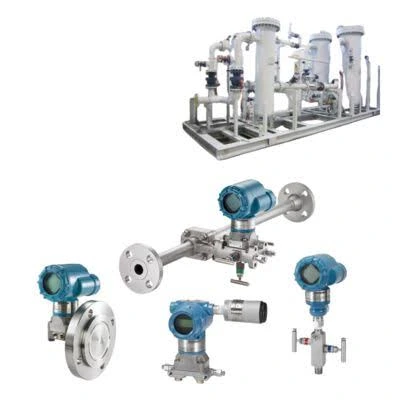
Process plants depend on dependable field instrumentation to keep operations within safe and efficient limits. Pressure measurement, in particular, underpins everything from flow calculation to tank inventory management. This guide breaks down the engineering fundamentals of a device commonly specified for that purpose — the Rosemount 3051 Pressure Transmitter — covering its build, performance data, and where it fits into global industrial operations.
1. Instrument Snapshot
| Attribute | Detail |
| Manufacturer | Emerson |
| Sensing Method | Capacitance-based sensor cell |
| Measured Variables | Differential, gauge, absolute pressure; level; flow |
| Output | 4–20 mA / HART; FOUNDATION Fieldbus; Profibus PA |
| Typical Accuracy | Up to ±0.025% of span |
| Turndown | Up to 100:1 |
| Enclosure Rating | IP66 / IP68 |
| Hazardous Area Approvals | ATEX, IECEx, FM, CSA (region-dependent) |
This snapshot table gives engineers a fast reference point before diving into the fuller specification breakdown below. When comparing pressure instrumentation across vendors, this data set is typically the first checkpoint procurement teams use to shortlist a Rosemount 3051 Pressure Transmitter against competing platforms for a given duty.
2. Engineering and Design Basics
Rather than being a single fixed device, the transmitter is a modular platform. A sensor module handles the physical pressure sensing, while an electronics housing manages signal conversion, diagnostics, and communication. This modularity is what allows one base platform to serve a wide span of pressure ranges — from very low differential pressures used in flow metering, up to several thousand psi for high-pressure process lines.
Wetted parts are available in several materials, including 316L stainless steel, Hastelloy C, and tantalum, so the same core electronics can be paired with a sensor suited to corrosive, sanitary, or high-purity process media. Process connections follow standard flange and manifold patterns, which keeps installation and future maintenance straightforward for plant technicians.
The electronics housing itself is typically available in aluminum or stainless steel casting, with a choice of conduit entry sizes and threading standards to match regional wiring practices. A separate terminal compartment isolates field wiring connections from the sensing electronics, which simplifies troubleshooting during commissioning and reduces the risk of moisture ingress affecting signal integrity over the instrument’s service life.
3. Specification Deep-Dive
Beyond the summary table, a few specification areas deserve closer attention for engineers doing detailed instrument selection:
- Accuracy and Stability: Reference accuracy figures alone don’t tell the full story — long-term stability (drift over multi-year service) is often the more meaningful number for maintenance planning, and this platform is built to minimize that drift.
- Static and Line Pressure Effects: For differential pressure applications, the transmitter’s sensor design is engineered to limit measurement error introduced by high static line pressure, which is a common source of inaccuracy in DP flow measurement.
- Temperature Compensation: Digital temperature compensation helps maintain accuracy across ambient and process temperature swings, which is relevant for outdoor installations exposed to seasonal extremes.
- Communication and Diagnostics: HART-based communication supports remote configuration and condition monitoring, reducing the need for technicians to physically access the transmitter for routine checks.
4. Why Reliability Matters Here
Unplanned instrument downtime has a direct cost in continuous process operations — a failed or drifting pressure signal can trigger unnecessary shutdowns or, worse, mask a real process upset. Three design elements contribute to dependable long-term operation:
- A sealed, vibration-resistant electronics housing suited to harsh plant environments.
- Onboard self-diagnostics that flag electronics faults or abnormal sensor readings before they affect the process.
- A sensor cell design intended to resist mechanical and thermal fatigue over repeated pressure cycling.
Together, these characteristics are why this instrument is frequently specified in safety-relevant or quality-critical loops, rather than only in general-purpose monitoring points.
5. Where It Gets Used
Application breadth is one of the more practical advantages of this transmitter family. Common deployment scenarios include:
- Upstream Oil & Gas: Wellhead and pipeline pressure monitoring
- Refining & Petrochemicals: Reactor and column differential pressure measurement
- Power Plants: Boiler drum level and steam header pressure
- Water/Wastewater Utilities: Hydrostatic tank level and filter differential pressure
- Life Sciences & Food Production: Sanitary process pressure monitoring with hygienic wetted materials
- Pulp & Paper: Pressure monitoring in corrosive digester environments
- Commercial HVAC: Differential pressure across air handling filters and dampers
Because the sensor and material configuration can be tailored per application, the same base design covers both light-duty utility monitoring and demanding hydrocarbon processing duties. In flow measurement applications specifically, the transmitter is often paired with a primary flow element such as an orifice plate or averaging pitot tube, where its differential pressure output feeds a flow computer or DCS function block to calculate volumetric or mass flow rate in real time.
6. Global Deployment Considerations
Facilities outside a single country’s regulatory footprint need instrumentation that can be certified locally without redesigning the measurement point. Certification coverage — ATEX for the European Union, IECEx as an internationally recognized scheme, and FM/CSA for North America — allows the same transmitter platform to be installed across plants located in different regions under the applicable local hazardous-area code.
For procurement teams managing instrumentation across multiple countries, this reduces the need to qualify separate vendors or part numbers per region, simplifying spares stocking and technician training across sites. Protocol flexibility (HART, FOUNDATION Fieldbus, Profibus PA) further supports integration into control systems already standardized in different parts of the world, whether a facility is in the Middle East, Southeast Asia, Europe, or the Americas.
For a supplier’s product category page, this breadth of certification and protocol support is a relevant selling point for buyers sourcing instrumentation for multi-country projects or standardizing a global vendor list.
7. Choosing the Right Model Variant
Before finalizing an order, buyers should confirm:
- Wetted material compatibility with the specific process fluid
- Required pressure range and turndown for the application
- Hazardous area classification at the installation site
- Communication protocol match with the existing control system
- Environmental/enclosure rating for the installation location
A supplier familiar with the platform’s configuration options can help match the correct sensor module, materials, and certification package to the intended duty, avoiding delays during commissioning.
Final Thought
For engineers specifying new instrumentation, technicians maintaining existing loops, and procurement managers sourcing across multiple facilities, the Rosemount 3051 Pressure Transmitter offers a well-documented specification set, established field reliability, and certification coverage suited to international projects — making it a recurring reference point in pressure measurement product comparisons worldwide.