
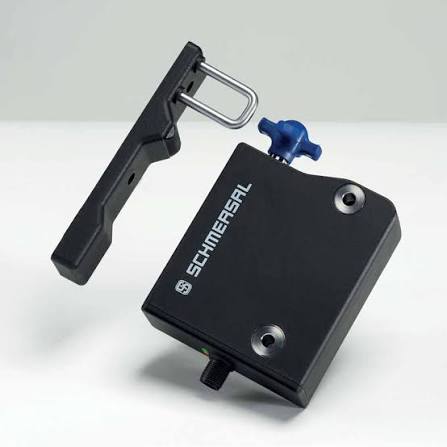
Machine guarding systems depend on components that perform predictably, resist harsh operating conditions, and meet internationally recognized safety standards. The Schmersal AZM300 is a solenoid interlock switch designed specifically for this purpose, combining non-contact RFID sensing with solenoid locking to secure guard doors on industrial machinery. This article provides a factual technical overview of the device, its specifications, and its relevance to industrial facilities across the United Arab Emirates.
What Is This Solenoid Interlock Switch?
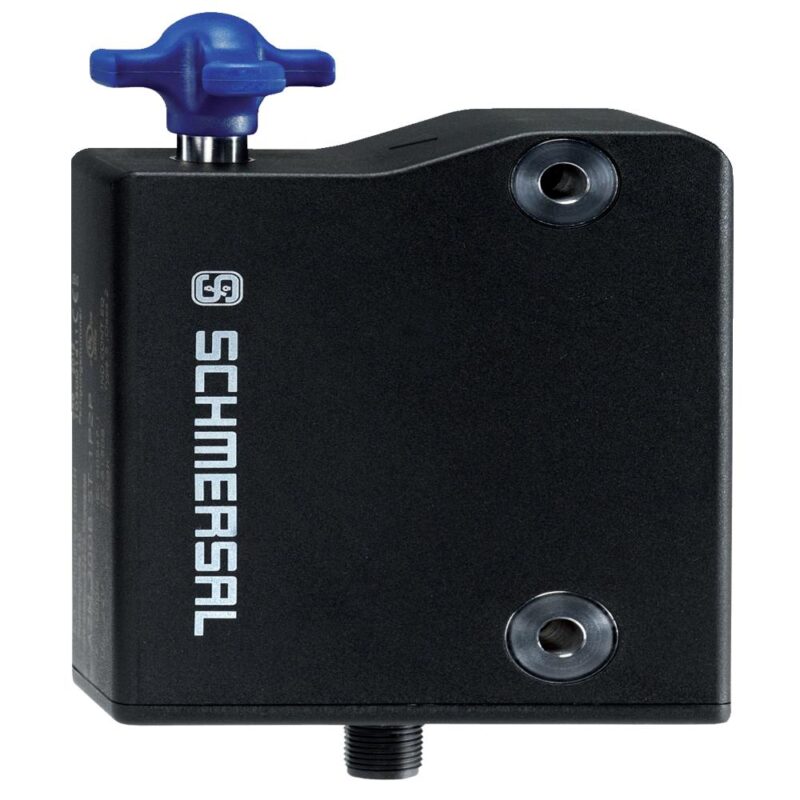
This is a solenoid-locking safety interlock switch used to monitor and secure movable guards—hinged doors, sliding panels, and access gates—on production machinery. Rather than relying on mechanical contact between the switch and actuator, the device uses radio frequency identification (RFID) to detect the presence of a coded actuator target. This non-contact operating principle reduces mechanical wear, tolerates a degree of actuator misalignment, and supports multiple coding levels for varying security requirements.
A distinguishing design feature is the external cross-shaped (Maltese cross) cam, which allows the actuator to be inserted from any of three sides. This gives installers flexibility to mount the switch on left-hinged, right-hinged, or sliding guard doors without needing separate hardware variants for each configuration.
Technical Specifications
Understanding the specifications of the interlock switch helps engineers and procurement managers assess suitability before integration into a safety circuit. Key technical data includes:
- Working principle: RFID-based non-contact sensing
- Solenoid locking force: Up to 1,000 N, sufficient to keep a guard door locked until hazardous conditions have subsided, including after power loss
- Safety classification: Suitable for use up to Performance Level e (PLe) and SIL 3, per EN ISO 13849-1
- Applicable standards: EN 60947-5-1, IEC 60947-5-3, IEC 61508
- Response time: Approximately 120 ms
- Duration of risk: Less than 200 ms
- Time to readiness: Approximately 5 seconds or less
- Switching distances: Rated switching distance (Sn) of 2 mm; assured switching distance (sao) of 1 mm; assured switch-off distance (sar) of 20 mm
- Mechanical life: 1,000,000 operations or more; for guards up to 5 kg at an actuating speed of 0.5 m/s, at least 50,000 operations
- Electrical connection: M12 connector plug, 8-pole, A-coded
- Ingress protection: IP69K, suitable for high-temperature and high-pressure wash-down environments
- Housing material: Glass-fibre reinforced thermoplastic, ventilated, and manufactured from ECOLAB-approved materials for hygienic applications
- Adjustable latching force: Two selectable settings, approximately 25 N and 50 N, for the non-safety-related latching function
- Series wiring: Up to 31 units can be wired in series with serial diagnostics, without reduction of the safety level
- Approvals: TÜV, cULus, CE, and ECOLAB
These specifications place this interlock switch among devices suitable for high-consequence safety circuits where extended service life and resistance to contamination are operational requirements.
Reliability and Precision
Reliability in a safety interlock is measured by consistent detection accuracy, resistance to false triggering, and a long mechanical service life. The AZM300 addresses these factors through its non-contact RFID detection method, which avoids the physical wear associated with mechanical switch contacts. Because the sensor does not require precise mechanical alignment to register a closed guard, it tolerates minor shifts in door position over time—common in industrial settings where guard doors experience repeated cycling, vibration, or thermal expansion.
Precision is further supported by the defined switching distances (Sn, sao, and sar), which allow engineers to calculate exact detection and release points during system design. The rated response time of approximately 120 ms and duration of risk under 200 ms are relevant figures for calculating overall stopping time and safety distance in accordance with ISO 13855.
Coding options add another layer of reliability. The base version accepts any compatible AZM300 actuator, the “I1” version is individually coded to a single actuator taught in during commissioning, and the “I2” version allows repeated teach-in, useful when an actuator needs replacement due to loss or damage. This tiered coding approach lets facilities balance operational flexibility against tamper resistance based on their risk assessment.
Typical Use Cases
The Schmersal AZM300 is applied across a range of industrial sectors where machine guarding is required by safety regulation or internal risk assessment:
- Food and beverage processing: IP69K protection and ECOLAB-approved materials make it suitable for equipment subject to frequent wash-down and sanitation cycles.
- Pharmaceutical and packaging lines: The compact design and hygienic construction support cleanroom-adjacent and packaging environments.
- Automotive and general manufacturing: High mechanical life and PLe/SIL 3 capability suit robotic cells, conveyor guarding, and automated production lines.
- Material handling and warehousing: Sliding and hinged door compatibility supports guarding on palletizers, wrapping machines, and automated storage systems.
In each case, the interlock’s role is the same: preventing access to a hazardous zone until the associated machinery has reached a safe state, and preventing the guard from being reopened while hazardous motion or energy is still present.
Relevance for UAE Industrial Facilities
Industrial and manufacturing operations across the UAE—spanning Dubai, Abu Dhabi, Sharjah, and the broader Emirates—operate under increasing expectations for machine safety compliance, particularly in sectors regulated by occupational health and safety frameworks and in facilities pursuing ISO 12100 and ISO 13849-1 alignment. The AZM300 supports this compliance objective through its PLe/SIL 3 rating and IEC/EN certification base, which are widely referenced in machinery risk assessments used by UAE-based engineering and EHS teams.
The region’s operating conditions are also a practical consideration. Facilities in the UAE frequently deal with high ambient temperatures, dust exposure, and in food processing or desalination-adjacent industries, wash-down and humidity requirements. The IP69K rating and ECOLAB-approved housing of the AZM300 are directly relevant to these conditions, reducing the likelihood of premature switch failure due to environmental ingress.
For procurement teams sourcing safety components in the UAE, working with a regional supplier such as Evaflux provides access to genuine Schmersal AZM300 units along with the compatible actuators, connectors, and documentation required for CE/UKCA-aligned machinery projects, along with local lead-time and technical support advantages over direct overseas procurement.
Installation and Integration Considerations
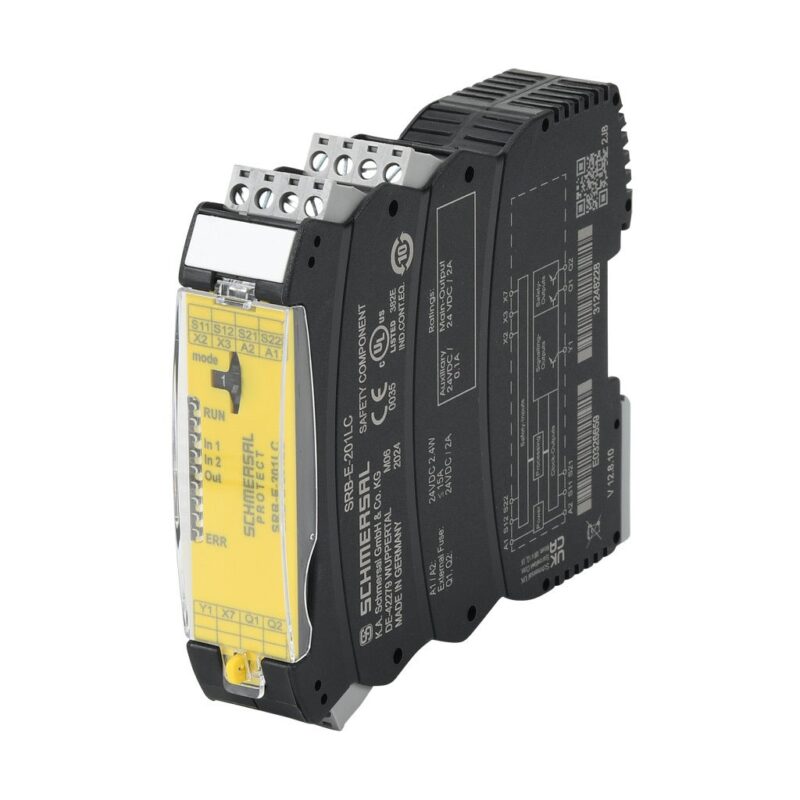
When specifying the AZM300 for a new or retrofit application, engineers should confirm the required coding level (basic, I1, or I2) based on the facility’s tamper-resistance needs, verify the mounting orientation against the three available actuating directions, and calculate the required safety distance using the switch’s rated response and risk times in line with ISO 13855. For installations requiring multiple guard points, the series-wiring capability—up to 31 units with serial diagnostics—can reduce cabling complexity while maintaining the safety level of the overall circuit, provided the associated safety-monitoring module supports this configuration.
Frequently Asked Questions
What safety performance level does the AZM300 achieve?
The AZM300 is rated for use up to Performance Level e (PLe) and SIL 3, in accordance with EN ISO 13849-1 and IEC 61508.
Is the AZM300 suitable for wash-down environments?
Yes. The switch carries an IP69K ingress protection rating and uses ECOLAB-approved housing materials, making it appropriate for food processing and other hygienic wash-down applications.
Can the AZM300 be used on both hinged and sliding doors?
Yes. Its cross-shaped cam design and three actuating directions allow a single unit to be mounted on left-hinged, right-hinged, or sliding guard doors.
How many AZM300 units can be wired together?
Up to 31 solenoid interlocks can be wired in series with serial diagnostics, without reducing the overall safety level of the circuit.
Does Evaflux supply the AZM300 across the UAE?
Yes. Evaflux supplies genuine AZM300 interlock switches, actuators, and accessories to industrial customers throughout the UAE, along with technical documentation and local support.
Conclusion
The Schmersal AZM300 is a solenoid interlock switch engineered for demanding industrial guarding applications, offering RFID-based non-contact detection, PLe/SIL 3 safety capability, and IP69K environmental protection. Its mounting flexibility, coding options, and series-wiring support make it applicable across food processing, pharmaceutical, automotive, and general manufacturing environments. For engineers, technicians, and procurement managers in the UAE evaluating machine guarding components, this interlock switch offers a documented, standards-compliant option suited to both the regulatory and environmental conditions typical of the region.