
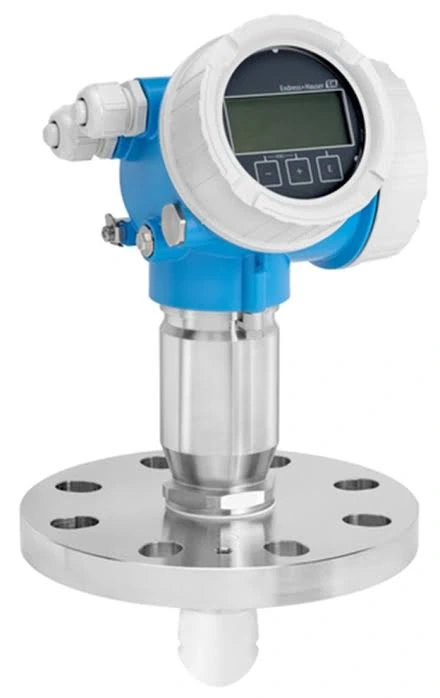
Accurate, reliable level measurement is a foundational requirement across process industries, from chemical manufacturing to water treatment and food production. The Endress Hauser Micropilot FMR60 is an 80 GHz free-space radar level transmitter engineered to deliver consistent, non-contact measurement performance regardless of vessel geometry, process conditions, or geographic location. This article provides a detailed technical overview of the device, its core specifications, and the operating scenarios where it is most commonly deployed by engineers, technicians, and procurement teams worldwide.
Product Overview
The Endress Hauser Micropilot FMR60 operates on the frequency modulated continuous wave (FMCW) principle. The sensor emits an electromagnetic wave whose frequency varies continuously over time; this wave travels toward the product surface, reflects back to the antenna, and the resulting frequency shift is used to calculate distance and, subsequently, level. Because the FMR60 is a non-contact instrument, it has no moving parts and no direct contact with the process medium, which reduces mechanical wear and maintenance requirements over the instrument’s service life.
A defining characteristic of this transmitter is its 80 GHz operating frequency, which is significantly higher than legacy 6 GHz or 26 GHz radar technologies. The higher frequency produces a smaller antenna and a narrower beam angle, allowing the signal to be focused more precisely on the product surface. This is particularly valuable in vessels with internal obstructions such as agitators, heating coils, or support structures, where a narrow beam reduces the likelihood of false echoes interfering with the measurement.
Technical Specifications
The Micropilot FMR60 is built for demanding process environments, and its specification sheet reflects that design intent:
- Measuring principle: Non-contact radar (FMCW), downward-looking
- Frequency band: W-band, 80 GHz
- Accuracy: Typically ±1 mm under reference conditions
- Maximum measuring range: Up to 50 m (164 ft)
- Process temperature: Approximately −40°C to +130°C (−40°F to +266°F), depending on antenna and seal configuration
- Process pressure: Vacuum up to approximately 16 bar (232 psi)
- Process connections: Threaded or flanged, with material options including PP and 316L stainless steel
- Wetted parts: PTFE antenna (drip-off design) for resistance to buildup and condensation
- Communication protocols: HART, with additional fieldbus and Ethernet-based options depending on configuration
- Diagnostics: Heartbeat Technology for self-monitoring and verification without process interruption
- Functional safety: Developed in accordance with IEC 61508, supporting SIL-rated safety instrumented systems
- Approvals: International explosion protection certifications, overfill prevention (WHG), and marine approvals are available depending on the ordered configuration
These specifications position the Micropilot FMR60 as a versatile instrument suitable for both standard industrial tanks and more demanding regulatory environments.
Reliability and Measurement Precision
Reliability is central to the design of this transmitter. The drip-off antenna geometry is shaped to shed condensation and process buildup, which helps maintain consistent signal transmission over time in humid or condensing atmospheres. Combined with refined signal-processing algorithms, the sensor is designed to maintain stable readings even when the process medium is affected by changing dielectric properties, temperature fluctuations, gas blankets, or vapor above the product surface.
The narrow beam angle inherent to 80 GHz technology further supports precision in vessels containing internal fittings. Because the signal can be focused tightly on the intended measurement path, the instrument is less prone to reflections from tank walls, ladders, or mixing equipment, which historically have been sources of measurement error in lower-frequency radar systems. For applications where measurement uncertainty must be minimized — such as custody transfer, inventory management, or safety-critical interlocks — this level of precision is a meaningful differentiator.
Heartbeat Technology adds a further layer of reliability by enabling continuous self-diagnostics. Technicians can verify device functionality and perform in-situ diagnostic checks without removing the sensor from the process, which reduces downtime and supports predictive maintenance programs.
Typical Use Cases
The Micropilot FMR60 is commonly specified for continuous, non-contact level measurement of liquids, pastes, and slurries. Representative applications include:
- Storage tanks: Long-term inventory monitoring of raw materials, intermediates, or finished liquid products
- Buffer tanks: Level control in intermediate process stages where surface conditions may be calm or moderately turbulent
- Process tanks with agitators: Measurement in vessels where mixing equipment and internal fittings would otherwise complicate radar signal interpretation
- Chemical processing: Monitoring of corrosive or reactive liquids where a non-contact sensor avoids material compatibility concerns associated with wetted mechanical components
- Water and wastewater treatment: Level monitoring in basins, clarifiers, and holding tanks
- Food and beverage production: Hygienic-compatible configurations for liquid ingredient and product tanks
- Oil, gas, and marine applications: Environments requiring explosion-protection certification and, where applicable, marine type approval
Because the Micropilot FMR60 performs reliably across calm, turbulent, and moving product surfaces, it is frequently selected as a standardized level measurement platform across multiple process areas within a single facility, simplifying spare parts inventory and technician training.
Worldwide Applicability
The Endress Hauser Micropilot FMR60 is engineered and certified for deployment across a broad range of international regulatory frameworks. Its compliance with IEC 61508 functional safety standards, along with available explosion-protection and overfill-prevention certifications, allows the instrument to be specified for projects in Europe, North America, the Middle East, Asia-Pacific, and other regions with varying compliance requirements. This global certification coverage is a key consideration for procurement managers sourcing instrumentation for multinational projects or standardizing equipment across facilities located in different countries.
For engineering, procurement, and construction (EPC) firms and end users managing multi-site operations, the ability to specify a single instrument platform that meets diverse regional standards reduces engineering complexity, simplifies documentation, and supports consistent maintenance procedures across geographically distributed assets.
Frequently Asked Questions
What is the measuring principle used by the Micropilot FMR60?
It uses frequency modulated continuous wave (FMCW) radar, a non-contact method that calculates level based on the frequency shift of a reflected electromagnetic wave.
What is the maximum measuring range of the device?
The instrument supports measurement distances of up to 50 m (164 ft), depending on the process conditions and antenna configuration.
Is the FMR60 suitable for vessels with internal obstructions?
Yes. Its narrow 80 GHz beam angle allows the signal to be focused on the product surface, reducing interference from agitators, ladders, and other internal fittings.
What accuracy can be expected from this transmitter?
Under reference conditions, the device typically achieves an accuracy of approximately ±1 mm.
Does the Micropilot FMR60 support functional safety applications?
Yes. It was developed in accordance with IEC 61508 and can be used in SIL-rated safety instrumented systems, subject to the ordered device configuration.
What industries commonly use this radar level transmitter?
Common sectors include chemical processing, water and wastewater treatment, food and beverage production, and oil, gas, and marine applications, among others.
Conclusion
The Endress Hauser Micropilot FMR60 combines 80 GHz radar technology, a durable drip-off antenna, and built-in diagnostic capability to deliver dependable, non-contact level measurement across a wide range of process conditions. Its documented accuracy, broad international certification coverage, and adaptability to challenging tank geometries make it a practical choice for engineers and procurement teams evaluating level instrumentation for both new installations and standardization projects across global operations.