
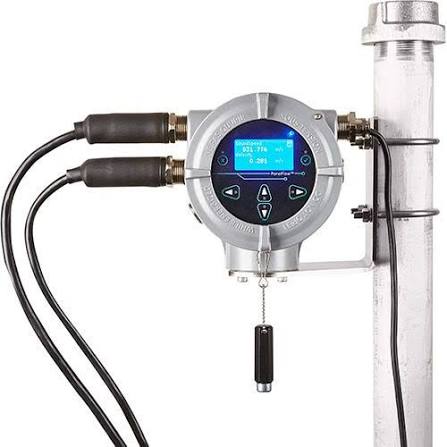
Accurate, non-intrusive flow verification is a routine requirement across water utilities, chemical plants, refineries, HVAC systems, and industrial process lines worldwide. The Panametrics TransPort PT900 is a clamp-on portable ultrasonic flow meter engineered to meet that requirement without cutting into pipework, stopping a process, or introducing a pressure drop. This article provides a technical overview of the instrument’s design, specifications, precision, and applications for engineers, technicians, and procurement teams evaluating portable flow measurement solutions.
What Is This Instrument?
The TransPort PT900 is a transit-time ultrasonic flow meter manufactured by Panametrics, a Baker Hughes business. It succeeds the long-established TransPort PT878, retaining the transducer performance the earlier model was known for while introducing a redesigned transmitter, clamping fixture, and an app-driven interface on an Android tablet. The system pairs transducers mounted externally on a pipe with a compact transmitter that calculates flow rate by measuring the transit time of ultrasonic signals traveling with and against the direction of flow. Because the sensors clamp onto the outside of the pipe, there is no pipe penetration, no process shutdown, and no risk of contamination — a significant advantage for facilities where downtime or product loss is costly.
The instrument uses Panametrics’ patented Correlation Transit-Time mode, which improves signal reliability in liquids that are not perfectly clean, including flows with small amounts of entrained solids or gas bubbles.
Technical Specifications
A clear specification set is essential for procurement and engineering teams comparing portable ultrasonic meters. Key technical data for the meter includes:
- Measurement principle: Clamp-on transit-time ultrasonic flow measurement, with Correlation Transit-Time mode for less-than-ideal liquids
- Fluid types: Acoustically conductive liquids, including most clean liquids and liquids containing limited entrained solids or gas bubbles
- Pipe size range: Standard 0.5 to 24 in. (15 to 600 mm); optional configurations up to 300 in. (7,500 mm) available on request
- Pipe wall thickness: Up to 3 in. (76.2 mm)
- Pipe materials: All metals and most plastics; consult the manufacturer for concrete, composite, heavily corroded, or lined pipes
- Accuracy: ±1% of reading for pipe sizes 2 in. (50 mm) and above; ±2% of reading for pipe sizes from 0.5 in. (15 mm) to under 2 in. (50 mm)
- Physical dimensions: Approximately 7.9 x 4.3 x 1.5 in. (200 x 109 x 38 mm)
- Weight: Approximately 3 lb (1.4 kg)
- Mounting: Soft strap around the pipe or magnetic clamping fixture
- Digital communication: Modbus via RS-485 port, Bluetooth wireless, and Micro-USB
- Battery: Rechargeable lithium-ion; 18–20 hours of continuous operation, more than four days in power-saver mode; charge time up to 3 hours
- Operating temperature: 0 to 45°C (32 to 113°F) while charging; -20 to 55°C (-4 to 131°F) during discharge/operation
- Transducer options: Standard clamp-on transducers plus high-temperature variants rated to -40 to 230°C for demanding process conditions
- User interface: Android tablet application for configuration, live readings, and data logging
- Compliance: Designed to meet CE Mark and UL Mark requirements when used with specified cables and accessories
These specifications position the meter as a mid-to-large pipe diameter solution, suited to applications ranging from small process lines to large-diameter water mains.
Reliability and Measurement Precision
Reliability in portable flow instrumentation depends on consistent signal acquisition, stable electronics, and a user interface that minimizes setup error. The Panametrics TransPort PT900 addresses these factors through several design choices. First, its transducer technology is inherited from the PT878, a meter with an established field record for signal strength and repeatability. Second, the redesigned clamping fixture is intended to reduce transducer misalignment, a common source of measurement error in clamp-on systems, by standardizing spacing and mounting geometry. Third, the app-driven tablet interface walks technicians through pipe and fluid parameter entry, reducing the likelihood of configuration mistakes that could otherwise compromise accuracy.
The stated accuracy figures — ±1% of reading on larger pipes and ±2% of reading on smaller diameters — are representative of a professional-grade instrument suitable for process monitoring, energy auditing, and diagnostic verification work. Because the meter operates non-intrusively, it also avoids the wear, fouling, and pressure-drop issues that can degrade the long-term accuracy of inline mechanical or intrusive flow sensors, making it a useful cross-check tool alongside permanently installed metering.
Typical Use Cases
This portable ultrasonic meter is applied across a broad range of industries and process conditions:
- Water and wastewater utilities: Verifying flow in distribution networks, treatment plants, and pump stations
- Building and facility management: Cooling and heating water system balancing, energy audits, and HVAC diagnostics
- Industrial process plants: Spot-checking and troubleshooting flow on chemical, glycol, and hydrocarbon lines
- Oil, gas, and refining: Temporary flow verification on crude oil and hydrocarbon transfer lines, including high-temperature applications
- Food and beverage production: Non-intrusive flow checks that avoid contact with the process fluid
- Meter calibration and verification: Cross-checking permanently installed meters without interrupting production
- Maintenance departments: Portable, multi-site use where technicians of varying experience levels need reliable readings without extensive programming
Because installation requires no pipe cutting or process interruption, the instrument is frequently used for temporary assessments, plant audits, and situations where a permanent meter is not justified or feasible.
Worldwide Applicability
The Panametrics TransPort PT900 is designed and documented for use across diverse regulatory, climatic, and industrial environments. Its wide pipe-size range (0.5 to 24 in., extendable to 300 in.), broad material compatibility, and operating temperature range spanning -20 to 55°C support deployment in facilities from temperate to hot climates. Compliance considerations for CE Mark and UL Mark requirements reflect readiness for both European and North American regulatory environments, while the meter’s use across water utilities, industrial plants, and energy audits globally demonstrates its relevance to procurement teams sourcing equipment for multi-region operations. For distributors and technical buyers evaluating portable ultrasonic flow instrumentation for projects outside a single domestic market, the PT900’s specification range and compliance profile make it a practical candidate for standardization across international facilities.
Frequently Asked Questions
What is the Panametrics TransPort PT900 used for?
It is used for non-intrusive, clamp-on measurement of liquid flow in pipes, commonly for process verification, energy audits, water distribution monitoring, and cross-checking permanently installed meters.
What pipe sizes does the PT900 support?
Standard configurations cover pipes from 0.5 to 24 in. (15 to 600 mm) in diameter, with optional setups available up to 300 in. (7,500 mm) upon request.
How accurate is the TransPort PT900?
Accuracy is ±1% of reading on pipes 2 in. (50 mm) and larger, and ±2% of reading on pipes from 0.5 to under 2 in. (15 to 50 mm).
Does the meter require cutting into the pipe?
No. The PT900 uses clamp-on transducers mounted externally, so there is no pipe penetration, pressure drop, or process interruption.
What liquids can the PT900 measure?
It measures acoustically conductive liquids, including most clean liquids and liquids with limited entrained solids or gas bubbles, across water, chemical, glycol, and hydrocarbon applications.
What operating temperature range does the PT900 support?
The transmitter operates for discharge/use between -20 and 55°C (-4 to 131°F), while optional high-temperature transducers extend measurement capability to -40 to 230°C for the process fluid contact points.
How is the PT900 different from the TransPort PT878?
The PT900 retains the transducer performance of the PT878 but introduces a new transmitter, clamping fixture, and an Android tablet-based user interface for faster, simpler setup.