
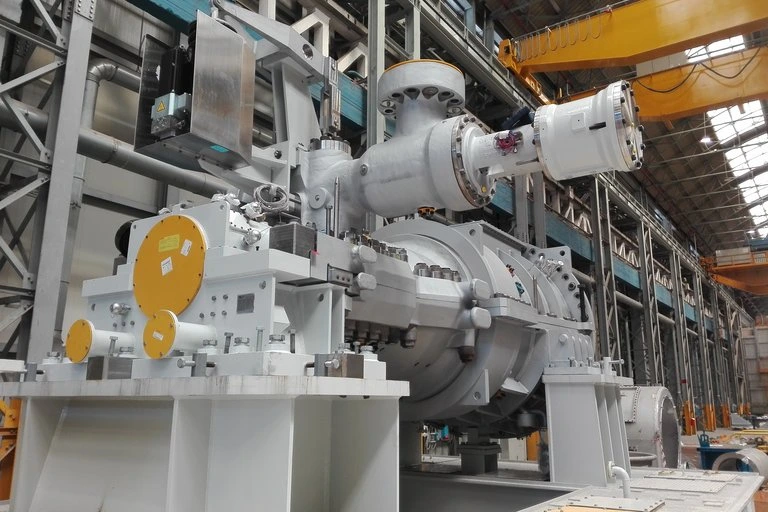
One of the most highly monitored assets in industrial operations are turbines. The performance and safety of any turbine, whether it is located in a combined-cycle power generation plant, an offshore platform or a hydroelectric plant, requires careful and effective monitoring of the vibration, temperature, speed and position data. As a Turbine Instrumentation Supplier Worldwide, Evaflux supplies genuine sensors, transmitters, monitoring modules and parts for control systems from well-known OEM manufacturers like Bently Nevada, GE Speedtronic and other well known manufacturers in the rotating equipment industry.
This article describes the technical aspects of turbine instrumentation, reliability and accuracy requirements that they need to meet, and the industries and regions in which the equipment is used.
Turbine Instrumentation Covers the following:
Turbine instrumentation involves the installation of sensors, transducers and monitoring equipment on gas, steam and hydro turbines to monitor the mechanical and thermal conditions of each turbine. The following are the normal instrumentation items for a turbine:
Vibration and proximity probes
Vibration and proximity probes include Eddy-current proximity probes and accelerometers (like in Bently Nevada’s 3300 and 3500 series) which measure shaft vibration, shaft displacement and shaft position (typically 0-25 mils or 0-635 microns), with frequency response of up to several kHz.
Speed and phase reference sensors
Speed and phase reference sensors – Magnetic pickups and Keyphasor probes are used to monitor the speed of the turbine and to provide phase angle balance and diagnostics information, typically in the range of near zero to >20,000 RPM, depending on the type of turbine.
Temperature Sensors
The sensors are RTD (usually of the Pt100 type, 3-wire configuration) and thermocouple (Type K, J or E) and are used to measure the temperature of bearings, lube-oil, and exhaust gas, and are typically accurate to Class A or better.
Pressure transmitters
Pressure transmitters – These measure lube-oil, hydraulic and process pressures that supply turbine governor and protection systems and are normally accurate within ±0.075% to ±0.1% of span.
Position and actuator feedback devices
Position and actuator feedback devices – LVDTs and rotary position transmitters provide information to the turbine control system on the position of the valve and actuator for governor and load control functions.
Monitoring and protection racks
Monitoring and protection racks – Rack-mounted monitors (e.g., Bently Nevada 3500 series) couple signals from field sensors to turbine control platforms like GE Speedtronic Mark IV, Mark V, Mark VI and Mark VIe systems.
These components can normally be used in the industrial temperature range of approximately -40°C to +85°C, have ingress protection rating of at least IP65/66/67 and are offered in ATEX/Ex-proof versions for the use in hazardous areas.
Reliability and Precision
Turbine Instrumentation Supplier Worldwide is a protection critical category for instruments. A trip signal and/or a shutdown may be delayed due to a fault in the vibration probe or an incorrect temperature reading, which has serious implications for operation and safety. Hence, reliability and accuracy are the two most critical attributes that a procurement team looks at.
Accuracy and Precision Requirements
The accuracy of calibration, repeatability and signal distribution, linear through the measurement range, constitute the definition of precision. For vibration monitoring systems, for instance, it is expected that the vibration monitor will have a linearity of less than 5% of full scale, while for temperature and pressure instruments the selection is based on defined accuracy classes that are suitable for the turbine protection logic.
Reliability and Component Sourcing
Reliability is achieved by a number of factors, including sourcing from certified OEMs and not using a gray-market part, the ability to trace calibration certificates, environmental testing to verify vibration and thermal cycling performance, and compatible validation with the specific revision of the turbine control system. Evaflux deals with each of these issues in a systematic manner – requirement review, technical evaluation of specifications and compatibility, sourcing from OEM channels and a quality and authenticity check prior to dispatch – such that each and every component supplied is performing exactly as specified, once installed.
Typical Use Cases
Turbine instrumentation is being used in various applications of rotating equipment:
Gas Turbines
Gas turbines used in combined cycle and simple cycle power generation where temperature spread monitoring and vibration protection of the exhaust is critical for combustion and rotor health.
Steam Turbines
Bearing vibration, differential expansion and eccentricity monitoring helps ensure safe start-up and load change in steam turbines found in thermal power plants and industrial cogeneration facilities.
Hydro Turbines
For large, slow speed rotating assemblies, the shaft runout, guide bearing vibration and thrust position monitoring are critical to the protection of hydro turbines.
Turbines, Compressor and Generator Trains
Machinery (turbines, compressor and generator trains) arranged in such a way that the same monitoring racks can extend over the whole train.
Oil & Gas Processing and Offshore Platforms
Oil & gas processing and offshore platforms, where turbine-driven compressors and pumps need to be instrumented in hazardous areas, Ex-proof.
Marine Propulsion Systems
Monitoring turbine and shaft for marine propulsion systems in line with classification society requirements.
Worldwide Applicability
The turbine platforms are commonly standardized around the world — the same type of monitoring platform (Bently Nevada, for example) or control panel (GE Speedtronic, for instance) used in a North American power plant is often used in plant applications in Europe, the Middle East, and Asia. This standardization makes a Turbine Instrumentation Supplier Worldwide relevant to procurement teams from all over the world: The parts numbers, calibration standards and control system interfaces are identical on installations worldwide, although the regulatory and voltage requirements differ by country.
Evaflux delivers to engineers and project managers in power generation, oil & gas, manufacturing and other industries across a range of areas, where they are required to deliver the parts that are exact matches or OEM equivalent to ensure uptime on turbines that can be decades old. The distributed, multi-region customer base is a focus area in servicing by means of rapid identification of legacy part numbers, secure global logistics and after sales technical support.
Working With Evaflux
The selection of the turbine instrumentation will depend on the exact specification (probe gap voltage, thread type, cable length, or transmitter output range) to match existing equipment for engineers and technicians. Procurement managers have to find the same specification, with documentation and lead times that work out the outage schedules. Both needs are solved by Evaflux which has immediate availability of authentic parts, documents authenticity before delivery and has technical documentation for installation and integration.
Evaflux is a long-term Turbine Instrumentation Supplier Worldwide, and is constantly building its portfolio of vibration monitoring equipment, temperature and pressure instrumentation as well as turbine control system components to enable operators in power generation, oil & gas and heavy manufacturing to continue to safely and within specification, get their rotating equipment running.