
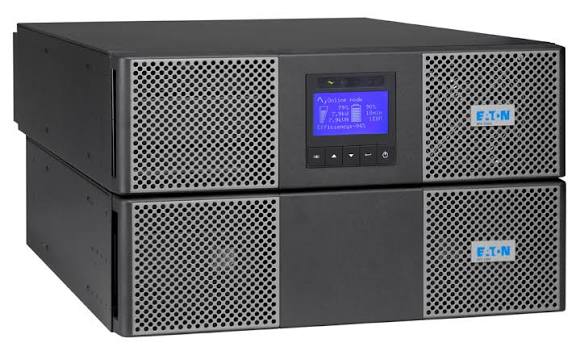
Reliable, clean power is a baseline requirement for IT infrastructure, medical equipment, industrial controls, and edge computing installations everywhere. The Eaton 9PX UPS is a double-conversion online uninterruptible power supply engineered to deliver consistent voltage and frequency regulation regardless of incoming power quality. This article walks through the product’s technical specifications, design philosophy, reliability features, and the environments where it is most commonly deployed, giving engineers, technicians, and procurement teams the factual detail needed to evaluate it for a project.
What Is the 9PX UPS?
It is a rack/tower convertible uninterruptible power system available across a power range of 700 VA up to 11 kVA. It uses online double-conversion topology, meaning incoming AC power is continuously converted to DC and back to AC before reaching connected equipment. This process isolates the load from raw utility power, correcting sags, surges, brownouts, frequency drift, and harmonic distortion in real time, with a transfer time of 0 milliseconds when switching to battery power. Because there is no switchover delay, sensitive servers, networking gear, and medical devices experience an unbroken, regulated power waveform.
The unit is designed as a modular platform: the same core design scales from small 2U models suited to a single server rack to larger 3U and 6U configurations that support higher-density data center rows, with lithium-ion battery variants available for extended service life and reduced footprint.
Technical Specifications
Understanding the underlying specifications is essential for correctly sizing a UPS to a load. Key parameters of the 9PX line include:
- Power range: 700 VA / 630 W up to 11,000 VA / 11,000 W, spanning single-phase 120V, 208V, and 200–240V output configurations.
- Topology: Online double-conversion with 0 ms transfer time.
- Efficiency: Up to 95% in standard online double-conversion mode and up to 98% in high-efficiency (ESS) mode, reducing energy draw and cooling load in a data hall.
- Power factor: 0.9, which allows the unit to support a higher real-power (watt) load per VA rating compared with UPS models using a lower power factor.
- Input frequency range: 40–70 Hz on 60 Hz systems, with a configurable frequency window on 50 Hz systems, supporting deployment on both 50 Hz and 60 Hz utility grids.
- Nominal voltage options: User-selectable settings including 120/208V, 120/240V, 100/200V, 110/220V, 115/230V, and 127/220V, covering the electrical standards used across most regions worldwide.
- Form factor: Rack (2U/3U/4U/6U) or tower orientation, with included rail kits or tower stands.
- Battery management: Eaton’s Advanced Battery Management (ABM) technology, which uses a multi-stage charging method to extend battery life, reduce recharge time, and provide predictive alerts on battery condition.
- Display and monitoring: Graphical LCD panel showing load level, runtime estimate, input/output status, and alarms; kWh energy metering is available on select models.
- Connectivity: Serial (RJ45), USB (HID), dry-contact relay interface, and an expansion slot for optional network management cards, including Eaton’s Gigabit Network Card, which supports both UL and IEC cybersecurity compliance standards.
- Runtime scalability: Compatible with external battery modules (EBMs) to extend backup time for longer outage coverage, with runtime tables published for each load percentage.
These specifications make the unit suitable for both standalone equipment protection and integration into larger, monitored power infrastructure.
Reliability and Precision
Reliability in a UPS is measured by how consistently it maintains output quality and how predictably it manages battery health over years of service. The 9PX platform addresses both areas directly. Its double-conversion design keeps output voltage and frequency within tight tolerances at all times, not only during an outage, which matters for equipment sensitive to power fluctuations such as precision instrumentation, imaging systems, and networking hardware.
On the battery side, ABM technology cycles between charge modes to avoid the overcharging conditions that shorten conventional VRLA battery life, while also running automatic self-tests at power-up and on a scheduled basis to confirm battery capacity before a real outage occurs. An internal automatic bypass allows continued power delivery to connected equipment in the event of an internal fault or overload condition, and the option for redundant N+X configurations (using external bypass units) further increases uptime assurance for critical installations.
Load segment control is another precision feature: administrators can configure sequential or prioritized shutdown of non-critical outlets to extend runtime for essential systems, and can remotely reboot locked network equipment without a site visit.
Typical Use Cases
Because this UPS platform spans a wide power range and supports multiple voltage standards, it is deployed across a range of environments:
- IT and data center racks: Protecting servers, storage arrays, and networking switches at the rack level, where compact 2U and 3U form factors conserve valuable rack space.
- Edge computing and network closets: Providing localized, unattended power protection for edge servers and telecom equipment outside a central data center.
- Healthcare and medical facilities: Supporting diagnostic and monitoring equipment where uninterrupted, regulated power is a patient-safety requirement.
- Industrial automation: Maintaining power to PLCs, control systems, and instrumentation in environments with variable or “dirty” incoming power.
- Education and public sector: Deployed across university data centers, K-12 IT rooms, and administrative facilities requiring dependable backup power.
- Harsh electrical environments: Its wide input frequency and voltage tolerance windows make it suitable for regions with less stable grid power.
Worldwide Applicability
A defining characteristic of the Eaton 9PX UPS is its adaptability to different electrical standards and grid conditions found across global markets. With selectable nominal voltages covering both 100–130V and 200–240V ranges, and support for both 50 Hz and 60 Hz utility frequencies, a single product family can be specified for installations in North America, Europe, the Middle East, Africa, and Asia-Pacific without requiring a fundamentally different product line. This is a practical advantage for multinational organizations and system integrators managing standardized IT and facility infrastructure across multiple countries: procurement teams can rely on one platform, one set of accessories, and one management software ecosystem regardless of the deployment region. Eaton’s global service and support network, along with regionally available accessory kits (rail kits, EBMs, network cards), further supports consistent specification and maintenance planning wherever the equipment is installed.
Software and Management
Each unit ships compatible with Eaton’s Intelligent Power Software, which supports monitoring and graceful shutdown across major operating systems and virtualization platforms, including VMware and Hyper-V. This allows IT teams to integrate UPS status and shutdown sequencing directly into existing infrastructure management workflows, and to centralize monitoring of multiple units across a facility or across sites.
Conclusion
The Eaton 9PX UPS combines double-conversion power protection, configurable voltage and frequency support, and predictive battery management in a scalable rack/tower form factor. Its specification range, from 700 VA to 11 kVA, along with selectable global voltage standards, positions it as a practical choice for organizations standardizing power protection across varied regions and equipment types. For engineers and procurement managers evaluating backup power solutions, the combination of documented efficiency ratings, transfer performance, and battery management technology provides a clear, verifiable basis for comparison against project requirements.
Frequently Asked Questions
What power range does the 9PX UPS cover?
The product line spans 700 VA / 630 W up to 11,000 VA / 11,000 W, across single-phase 120V, 208V, and 200–240V output models.
What UPS topology does the 9PX use?
It uses online double-conversion topology with a 0 ms transfer time, meaning the load is continuously powered from the inverter rather than switching to battery only during an outage.
Can the Eaton 9PX UPS be used outside North America?
Yes. It supports user-selectable nominal voltages (including 100/200V, 110/220V, 115/230V, and 127/220V) and both 50 Hz and 60 Hz frequencies, making it compatible with electrical standards used in most regions.
How does the 9PX extend battery life?
It uses Eaton’s Advanced Battery Management (ABM) technology, a multi-stage charging method that reduces overcharge stress, along with automatic self-tests to verify battery condition.
Can runtime be extended beyond the internal battery?
Yes, external battery modules (EBMs) can be connected to most models to extend backup runtime for longer outages.
What connectivity options are available for monitoring?
Standard connectivity includes RS-232 (RJ45), USB (HID), and a dry-contact relay interface, with an expansion slot for optional network management cards, including Eaton’s Gigabit Network Card.
Is the 9PX UPS suitable for data center use?
Yes, its compact 2U/3U/6U rack-mountable form factors, high efficiency (up to 98% in high-efficiency mode), and 0.9 power factor make it well suited to rack-level and small-to-mid-size data center deployments.