
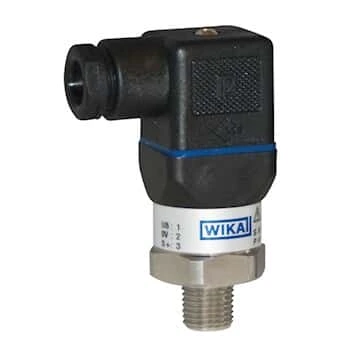
The WIKA A10 Pressure Sensor is a compact, general-purpose pressure transmitter engineered for industrial and OEM pressure measurement. Recognized as one of the most widely deployed instruments in its class, it is used across manufacturing plants, mobile equipment, and process facilities on every continent. This article provides a technical, fact-based overview of the sensor’s design, specifications, and application scope to help engineers, technicians, and procurement teams evaluate its suitability for their systems.
Product Overview
The A10 series is a piezoresistive, thin-film pressure transmitter built around an all-stainless-steel welded measuring cell. This construction removes the need for internal soft-sealing elements, which are a common point of failure in lower-cost transmitters exposed to temperature cycling or aggressive media. The result is a rugged, compact device suited to integration into a wide variety of machine designs, from hydraulic power units to compressor skids and packaging equipment.
Because it covers gauge, vacuum, and absolute pressure measurement across a broad set of ranges, the sensor is frequently specified as a drop-in replacement for older analog transmitters, including WIKA’s retired ECO-1 series. Its combination of a compact footprint, standard electrical and process connections, and long field history has made it a default choice for OEM machine builders and plant maintenance teams alike.
Technical Specifications
Understanding the core specifications is essential when selecting the correct variant for a given application. Key parameters of the sensor include:
- Measuring principle: Piezoresistive pressure sensor with thin-film sensor technology
- Pressure ranges: From 0–15 psi up to 0–10,000 psi (equivalent metric and bar ranges available, including 0–250 bar variants)
- Pressure types: Gauge, vacuum, and absolute pressure
- Accuracy: ±0.5% of span (BFSL), with a ±0.25% option available for tighter measurement requirements
- Output signal: 4–20 mA (2-wire) or 0–10 V / 0–5 V (3-wire), depending on configuration
- Power supply: 8–30 VDC for current output; 14–30 VDC for voltage output configurations
- Process connection: 1/4″ NPT male as standard, with alternative thread options available
- Electrical connection: DIN EN 175301-803 (DIN 43650) plug connector
- Wetted parts material: 316L stainless steel
- Housing: 316L stainless steel body with non-wetted nitrile rubber and polyamide components
- Operating temperature range: 0°C to +80°C (32°F to +176°F)
- Ingress protection: IP65, per IEC 60529, when mated with a compatible connector
- Overpressure/burst limits: Typically 200% overpressure safety and 500% burst pressure relative to nominal range
- Shock and vibration resistance: 500 g shock resistance per IEC 60068-2-27; 10 g vibration resistance per IEC 60068-2-6
- Compliance: CE marking (Pressure Equipment Directive, EMC Directive) and RoHS conformity; cULus approval available on select models
These specifications position the sensor as a mid-range industrial transmitter that balances precision, robustness, and cost-efficiency — a profile that explains its continued popularity in OEM design and plant instrumentation upgrades.
Reliability and Build Quality
Reliability is central to the design philosophy behind this transmitter series. The welded stainless-steel measuring cell eliminates elastomer seals at the pressure-sensing interface, reducing long-term drift and the risk of leakage caused by seal degradation. This is particularly relevant in applications involving frequent pressure cycling, where seal-based designs tend to wear faster.
The transmitter is rated to withstand up to 100 million load cycles while maintaining consistent measurement performance, a figure that reflects extensive fatigue testing during development. Combined with its shock and vibration ratings, this makes the sensor well suited to mobile hydraulics, reciprocating compressors, and other environments where mechanical stress is a constant factor rather than an occasional event.
Electrical protection features — including overvoltage protection, short-circuit protection, and reverse-polarity protection — further reduce the likelihood of field failures caused by wiring errors or transient voltage spikes, which are common in industrial electrical environments.
Precision and Measurement Performance
Precision in pressure measurement directly affects process control quality, energy efficiency, and equipment protection. The WIKA A10 Pressure Sensor delivers ±0.5% of span accuracy as standard, calculated using the best-fit straight line (BFSL) method, with an optional ±0.25% accuracy class for applications requiring tighter tolerances, such as calibration benches or precision test rigs.
Accuracy is validated under standardized reference conditions defined in IEC 61298-1, covering controlled humidity, temperature, and atmospheric pressure during testing. This standardized validation approach gives engineers a consistent basis for comparing the A10 against alternative transmitters when specifying instrumentation for a new system or replacing an existing sensor during a retrofit.
Typical Use Cases
The sensor’s combination of ruggedness, moderate cost, and broad range coverage suits a wide span of industrial contexts:
- Hydraulics and pneumatics: Monitoring supply pressure in hydraulic power units, cylinders, and pneumatic control circuits
- Process control and automation: Providing pressure feedback for PLC-based control loops in manufacturing lines
- Machine building (OEM): Integrated into compressors, pumps, packaging machines, and material-handling equipment
- Mobile equipment: Used on construction, agricultural, and material-handling vehicles subject to vibration and shock
- HVAC and refrigeration systems: Measuring system pressure for compressor protection and cycle control
- Test and calibration setups: Where the higher-accuracy variant supports repeatable reference measurements
Across these use cases, the A10 transmitter is generally chosen when a project requires dependable, standards-compliant pressure measurement without the cost premium of a laboratory-grade instrument.
Worldwide Applicability and Relevance
Industrial pressure measurement requirements are broadly consistent across regions — CE, RoHS, and cULus compliance allow the A10 series to be specified in European, North American, and many Asian and Middle Eastern facilities without requiring a region-specific substitute. Its standard NPT and DIN connection formats align with common global instrumentation practices, simplifying installation, spares management, and technician training for organizations that operate facilities in multiple countries.
For procurement teams sourcing instrumentation across a distributed supply chain, this uniformity reduces the complexity of maintaining a single approved parts list across regional plants. Evaflux supplies the WIKA A10 Pressure Sensor to industrial buyers internationally, supporting engineering teams that need consistent instrumentation specifications regardless of where a facility is located.
Why Specify This Pressure Transmitter
For engineers evaluating instrumentation options, the A10 series offers a documented balance of accuracy, mechanical durability, and standardized compliance. Its long field history and broad range coverage reduce specification risk on new designs, while its status as a common replacement part simplifies maintenance planning for existing installations. Procurement managers benefit from predictable lead times and a well-established global supply chain, which supports multi-site sourcing strategies without introducing part variability between regions.
Frequently Asked Questions
What pressure ranges does the A10 sensor cover?
The device is available in ranges from 0–15 psi up to 0–10,000 psi, along with equivalent metric ranges in bar, mbar, kPa, and MPa, covering gauge, vacuum, and absolute pressure measurement.
What accuracy class does the sensor offer?
Standard accuracy is ±0.5% of span (BFSL), with an optional ±0.25% accuracy class for applications requiring tighter measurement tolerances.
What output signals are available?
The transmitter is available with a 4–20 mA two-wire output or a 0–10 V / 0–5 V voltage output, depending on the configuration ordered.
What materials are used in the wetted parts?
Wetted parts are constructed from 316L stainless steel, providing broad chemical compatibility with common industrial media, including water, oils, and many process gases.
Is the sensor suitable for mobile and high-vibration equipment?
Yes. It is rated for 500 g shock resistance and 10 g vibration resistance, making it appropriate for mobile hydraulics and equipment subject to continuous mechanical stress.
Can this sensor replace an older WIKA ECO-1 transmitter?
Yes. The A10 series was introduced as the direct successor to the retired ECO-1 series and shares comparable mounting and connection formats in most configurations.
Is this pressure transmitter compliant for use in Europe and North America?
Yes. The transmitter carries CE marking under the applicable EU directives and RoHS conformity, and cULus-approved variants are available for markets requiring North American electrical certification.
Conclusion
The WIKA A10 Pressure Sensor remains a widely specified instrument for industrial pressure measurement due to its documented accuracy, welded stainless-steel construction, and broad international compliance. Its consistent specification across regions makes it a practical choice for engineering and procurement teams managing instrumentation standards across multiple facilities. Buyers evaluating this transmitter for a new design or a maintenance replacement can reference the specifications above to confirm compatibility with their system’s pressure range, output requirements, and environmental conditions.