
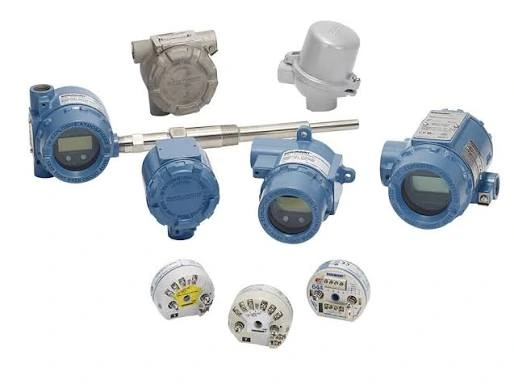
Accurate temperature measurement underpins safe and efficient operation across nearly every process industry, from oil and gas refineries to pharmaceutical manufacturing plants. Among the instruments engineers and procurement teams rely on for this task, the Rosemount 644 Temperature Transmitter has become a widely specified device due to its measurement accuracy, configuration flexibility, and proven field reliability. This article provides a factual, technical overview of the transmitter, its specifications, and its applications for buyers evaluating temperature measurement solutions on a global scale.
What Is the Rosemount 644?
The Rosemount 644 is a two-wire, loop-powered temperature transmitter designed to convert signals from resistance temperature detectors (RTDs), thermocouples (TCs), or ohms/millivolt inputs into a standardized 4–20 mA HART signal, or optionally into FOUNDATION Fieldbus or PROFIBUS PA digital protocols. It is manufactured for use in head-mount, rail-mount, and remote-mount configurations, allowing it to be integrated into a wide variety of instrumentation architectures.
Designed for both single-sensor and dual-sensor input, the transmitter can accept redundant or differential temperature measurements, offering added functionality for processes where sensor backup or temperature differential monitoring is required. This flexibility is one reason the device continues to be specified across diverse industrial sectors.
Technical Specifications
Procurement managers and engineers evaluating this instrument typically review the following core specifications:
- Input Types: RTD (2, 3, or 4-wire), thermocouple (types B, E, J, K, N, R, S, T), ohms, and millivolt inputs
- Output Signal: 4–20 mA with HART protocol (versions 5 and 7); FOUNDATION Fieldbus and PROFIBUS PA variants available
- Accuracy: Reference accuracy as fine as ±0.10°C, depending on sensor type and configuration
- Ambient Operating Temperature Range: Typically -40°C to 85°C (-40°F to 185°F), with extended range options for specific enclosure types
- Update Rate: Fast update rate suitable for dynamic process monitoring
- Sensor Inputs: Single or dual-sensor capability with sensor drift alert and differential/average temperature calculation
- Mounting Options: Head-mount (DIN Form B), rail-mount (DIN rail), and remote-mount enclosures
- Diagnostics: Continuous self-diagnostics including sensor drift alert, minimum/maximum temperature tracking, and power supply monitoring
- Hazardous Area Certifications: Options available for ATEX, IECEx, FM, CSA, and other regional certifications depending on the ordering configuration
- Communication Protocols: HART, FOUNDATION Fieldbus, PROFIBUS PA
These specifications make the transmitter suitable for a broad range of process conditions, and buyers should always confirm the exact configuration against their specific project documentation and hazardous area classification requirements.
Reliability and Precision
Reliability is one of the primary considerations for engineers selecting a temperature transmitter, particularly in critical process applications where downtime carries significant cost. This model is built with diagnostic capabilities that continuously monitor sensor health, helping to identify sensor drift or degradation before it affects process data quality. This proactive diagnostic approach supports predictive maintenance strategies and reduces the likelihood of unplanned shutdowns caused by faulty temperature readings.
In terms of measurement precision, the transmitter’s digital signal processing and sensor matching capabilities allow it to minimize measurement error across varying process conditions. When paired with a matched RTD sensor, the combined system accuracy can be significantly improved, which is particularly valuable in applications where small temperature deviations have a meaningful impact on product quality or safety margins, such as in chemical reactions or pharmaceutical batch processing.
The transmitter’s robust housing options, along with its ability to operate reliably across wide ambient temperature ranges, further contribute to its consistent field performance in both indoor and outdoor installations, including in extreme climates.
Typical Use Cases
The versatility of this transmitter allows it to be deployed across a wide range of industries and applications, including:
- Oil and Gas: Monitoring temperatures in pipelines, storage tanks, and refining processes, including in hazardous area installations
- Chemical and Petrochemical Processing: Ensuring precise temperature control for reactions, distillation columns, and heat exchangers
- Power Generation: Measuring temperatures in boilers, turbines, and cooling systems
- Pharmaceutical and Life Sciences: Supporting temperature-sensitive processes that require tight tolerances and validated documentation
- Food and Beverage Processing: Monitoring pasteurization, sterilization, and storage temperatures
- Water and Wastewater Treatment: Tracking process and effluent temperatures for regulatory compliance
- HVAC and Building Automation: Providing reliable temperature feedback for large-scale climate control systems
Because the transmitter supports multiple communication protocols and mounting configurations, it can be integrated into both legacy analog systems and modern digital fieldbus architectures, making it a practical choice for plants undergoing instrumentation upgrades or expansions.
Worldwide Applicability
The Rosemount 644 Temperature Transmitter is specified and installed in process plants across nearly every region of the world, from North America and Europe to the Middle East, Asia-Pacific, and Latin America. Its compliance with multiple international hazardous area certification standards, including ATEX and IECEx for European and international markets, along with FM and CSA approvals commonly required in North America, allows procurement teams to source a single product family suitable for multi-site, multi-region projects.
This global relevance is particularly valuable for EPC (engineering, procurement, and construction) firms and multinational operators who require standardized instrumentation across facilities located in different regulatory jurisdictions. By specifying this model as a standard across global sites, organizations can simplify spare parts inventory, technician training, and maintenance procedures, regardless of a facility’s geographic location.
Additionally, the availability of multiple communication protocol options ensures compatibility with distributed control systems (DCS) and asset management platforms used internationally, further reinforcing the transmitter’s suitability for global procurement strategies.
Selecting the Right Configuration
When evaluating the Rosemount 644 for a specific project, engineers and procurement managers should consider the following factors:
- Sensor type and input requirements (RTD, thermocouple, or dual-sensor configuration)
- Required accuracy and turndown for the specific process
- Mounting style (head-mount, rail-mount, or remote-mount)
- Communication protocol compatibility with existing control systems
- Hazardous area certification requirements specific to the installation region
- Ambient and process temperature ranges at the installation site
Working with a knowledgeable instrumentation supplier can help ensure the correct configuration is selected to match both technical requirements and regional compliance standards.
Conclusion
The Rosemount 644 Temperature Transmitter remains a widely used instrument for process industries requiring accurate, reliable, and configurable temperature measurement. Its combination of flexible input options, strong diagnostic capabilities, and broad international certification support make it a practical choice for engineers and procurement teams managing projects across multiple global regions. For technical documentation, configuration assistance, or sourcing support, procurement teams are encouraged to consult detailed datasheets and reach out to qualified instrumentation suppliers.
Frequently Asked Questions (FAQ)
Q1: What is the Rosemount 644 used for?
It is used to convert temperature signals from RTDs, thermocouples, or ohms/millivolt inputs into a standardized 4–20 mA HART, FOUNDATION Fieldbus, or PROFIBUS PA signal for process monitoring and control.
Q2: What sensor types are compatible with the Rosemount 644?
It supports RTDs (2, 3, or 4-wire), thermocouples (types B, E, J, K, N, R, S, T), as well as ohms and millivolt inputs.
Q3: What accuracy can be expected from this transmitter?
Depending on configuration and sensor pairing, the transmitter can achieve a reference accuracy as fine as ±0.10°C.
Q4: Is the Rosemount 644 Temperature Transmitter suitable for hazardous area installations?
Yes, it is available with various hazardous area certifications, including ATEX, IECEx, FM, and CSA, depending on the ordering configuration selected.
Q5: Can the Rosemount 644 support dual-sensor inputs?
Yes, it supports dual-sensor configurations, enabling redundancy, differential temperature measurement, and sensor drift alerts.
Q6: What mounting options are available?
The transmitter is available in head-mount (DIN Form B), rail-mount, and remote-mount configurations.
Q7: Is the Rosemount 644 suitable for global projects?
Yes, due to its multiple international certifications and communication protocol options, it is commonly specified for multi-region and multinational installations.