
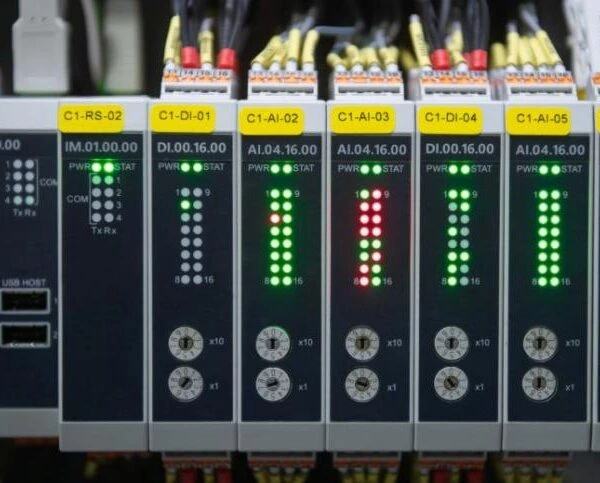
Industrial automation across the United Arab Emirates depends on control hardware that performs consistently under demanding conditions — high ambient temperatures, dusty environments, continuous duty cycles, and strict uptime requirements. Programmable Logic Controllers (PLCs) form the backbone of this automation infrastructure, and Siemens remains one of the most widely specified brands in the region’s manufacturing, oil and gas, water treatment, and process industries. As a Siemens PLC Supplier UAE, Evaflux works directly with engineers, technicians, and procurement teams to source genuine controllers that meet local operating requirements and international compliance standards.
This guide provides a factual, technical overview of Siemens PLC systems, their specifications, and their practical relevance to UAE-based industrial operations.
What Is a Siemens PLC?
A Programmable Logic Controller is an industrial digital computer designed to automate electromechanical processes. Siemens produces several PLC families, most notably the SIMATIC S7 series, which includes the S7-1200, S7-1500, S7-300, and S7-400 lines, alongside the newer SIMATIC S7-1500 Advanced Controllers. These systems control everything from simple conveyor belts to complex, multi-zone process plants, using ladder logic, structured text, or function block diagrams programmed through the TIA Portal (Totally Integrated Automation Portal) software environment.
Each PLC consists of a central processing unit (CPU), input/output (I/O) modules, communication interfaces, and power supply modules, all mounted on a standard DIN rail or backplane. The modular design allows engineers to scale a system from a handful of I/O points to several thousand, depending on the application.
Technical Specifications
Siemens PLCs are engineered to define performance and environmental benchmarks. Typical specifications for the S7-1200 and S7-1500 series include:
- Operating temperature range: 0°C to 55°C (horizontal mounting), suitable for climate-controlled panels; UAE installations typically pair units with appropriate enclosure cooling given ambient temperatures that regularly exceed 45°C.
- Processing speed: Bit operations executed in the range of 0.05 to 1 microsecond, depending on CPU model.
- Memory capacity: Work memory ranging from 100 KB (entry-level CPUs) up to 30 MB or more (high-performance CPUs).
- Communication protocols: PROFINET, PROFIBUS, Modbus TCP, OPC UA, and Industrial Ethernet, enabling integration with SCADA systems, HMIs, and enterprise-level MES platforms.
- I/O capacity: Digital and analog I/O modules supporting voltages from 24V DC to 230V AC, with expansion capability for distributed I/O over PROFINET or PROFIBUS networks.
- Certifications: UL, CSA, ATEX (for hazardous area applications), and IEC 61131-3 programming standard compliance.
- Ingress protection: Base units typically rated IP20; when installed in appropriately rated enclosures, systems can meet IP54, IP55, or higher for dust and moisture protection — a relevant consideration in coastal and desert environments.
These specifications matter directly to procurement decisions, since matching CPU processing capacity, memory, and I/O count to actual plant requirements avoids both under-provisioning and unnecessary cost.
Reliability and Precision
Siemens PLCs are built for continuous industrial operation, often rated for mean time between failures (MTBF) in excess of 400,000 hours for standard CPU models. This reliability stems from solid-state design with no moving parts in the core processing unit, extensive electromagnetic compatibility (EMC) testing, and diagnostic self-monitoring functions that flag faults before they cause unplanned downtime.
Precision in Siemens systems is delivered through high-resolution analog input/output modules (commonly 12-bit to 16-bit resolution), deterministic scan cycles, and synchronized motion control functions available in the S7-1500 Technology CPUs. For processes requiring tight tolerances — such as batching, dosing, or motion-critical packaging lines — this level of repeatability is a core reason the platform remains widely specified by control system integrators.
Redundancy options, including the S7-1500R/H fault-tolerant CPU line, allow for near-zero downtime in critical applications such as water treatment plants or continuous process manufacturing, where an unplanned stoppage carries significant operational or safety cost.
Typical Use Cases in the UAE
The UAE’s industrial base spans oil and gas processing, desalination and water treatment, food and beverage manufacturing, cement and construction materials, and increasingly, renewable energy and smart infrastructure projects. Siemens PLC Supplier UAE are applied across each of these sectors in comparable ways:
- Oil and gas: Process control for gathering stations, pump skids, and custody transfer metering, often paired with ATEX-rated I/O for hazardous zones.
- Water and wastewater treatment: SCADA-integrated control of pumping stations, filtration systems, and desalination units, where uptime and remote monitoring are operationally essential.
- Manufacturing: Discrete and batch process automation in food processing, packaging, and materials handling, using S7-1200 or S7-1500 CPUs depending on I/O count and required processing speed.
- Building and infrastructure automation: HVAC, elevator, and utility management systems in large commercial and mixed-use developments, a growing segment given the UAE’s continued urban development.
- District cooling and energy management: Load balancing and monitoring across large-scale cooling plants, a category particularly relevant to the region’s climate.
Across these applications, the common requirement is dependable performance in high-heat, high-dust conditions, combined with the ability to integrate into existing SCADA and MES infrastructure — both areas where Siemens’ documented specifications and regional support network provide practical advantages.
Why Sourcing Locally Matters
Procurement teams sourcing Siemens PLCs for UAE projects generally weigh several factors beyond unit price: authenticity of the hardware, availability of firmware and software licensing, lead time for replacement parts, and access to technical support familiar with regional installation conditions. Working with an established Siemens PLC Supplier UAE reduces the risk of counterfeit components, which is a documented concern in industrial automation markets, and shortens the logistics chain for time-sensitive maintenance and replacement orders.
Evaflux supplies genuine Siemens SIMATIC controllers, I/O modules, HMIs, and associated components, with documentation and traceability that procurement and quality teams require for compliance audits. This includes support for specifying the correct CPU, memory, and communication modules for a given application, based on the technical parameters outlined above rather than generic recommendations.
Selecting the Right Siemens PLC
When evaluating a Siemens PLC for a specific UAE project, engineers typically assess:
- I/O count and type — digital versus analog, and whether distributed I/O over PROFINET is required for geographically spread equipment.
- Processing and memory requirements — driven by program complexity, number of function blocks, and data logging needs.
- Communication requirements — compatibility with existing SCADA, MES, or third-party HMI systems.
- Environmental rating — enclosure specification needed to manage ambient heat and dust exposure common in the region.
- Redundancy needs — whether the application justifies a fault-tolerant CPU configuration.
A supplier with direct technical knowledge of these parameters helps ensure the specified hardware matches actual operating conditions, rather than defaulting to oversized or undersized configurations.
Conclusion
Siemens PLC systems remain a well-documented, widely deployed standard for industrial automation, offering measurable reliability, precision, and integration flexibility. For engineers, technicians, and procurement managers operating in the UAE, working with a knowledgeable Siemens PLC Supplier UAE ensures access to genuine hardware, accurate technical specification support, and a supply chain suited to the region’s operating conditions. Evaflux provides this combination of product authenticity and technical guidance for organizations planning new automation projects or maintaining existing Siemens-based control systems.