
Understanding the Bentley Nevada 3300 XL
The Bentley Nevada 3300 XL Proximity Probe is an eddy current displacement sensor used to measure the radial and axial position of a rotating shaft relative to a fixed reference point, as well as the dynamic vibration of that shaft. It is a core component of condition monitoring systems installed on turbomachinery that relies on fluid-film (journal) bearings, including turbines, compressors, pumps, and large electric motors and generators.
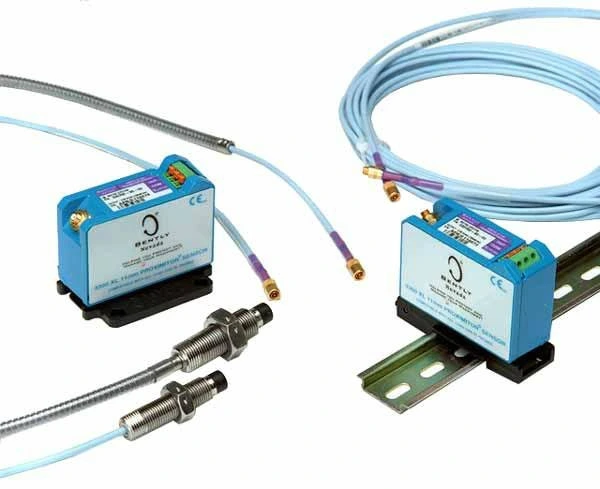
As part of a three-piece transducer system probe, extension cable, and Proximitor sensor the device converts the physical gap between the probe tip and a conductive target into a proportional DC voltage output. This output is used both for continuous monitoring and for protective shutdown logic in critical rotating equipment. Because these machines are frequently the single most expensive and operationally critical assets in a plant, the accuracy and dependability of the measurement chain has direct consequences for uptime, safety, and maintenance planning.
Key Features and Technical Specifications
The system is built around interchangeability and consistency, which simplifies both initial installation and long-term maintenance. Key technical characteristics include:
- Probe tip sizes: Commonly available in 5 mm, 8 mm, 11 mm, and 25 mm variants, along with NSv (narrow-space) configurations for restricted mounting locations.
- Measurement principle: Eddy current sensing, producing an output voltage directly proportional to the gap between the probe tip and an observed conductive (typically AISI 4140 steel) target, capturing both static position and dynamic vibration.
- Standards compliance: The standard 8 mm, 5-metre system is designed to meet API 670 (4th Edition) requirements covering mechanical configuration, linear range, accuracy, and temperature stability, a specification widely referenced in petrochemical and power generation procurement.
- Interchangeability: Probes, extension cables, and Proximitor sensors are interchangeable within a matched electrical-length system, removing the need for individual bench calibration of components.
- Temperature performance: Depending on model, probes are rated across wide operating ranges, with some variants specified from approximately -55°C to +180°C, suitable for both cold ambient installations and hot process environments.
- Pressure sealing: Certain probe variants (including underwater and NSv types) use Viton O-rings and are rated to seal against several bars of pressure, with options for higher-pressure applications.
- Connectors: ClickLoc-style connectors allow finger-tight installation, reducing field wiring time and improving connection reliability compared to older screw-type terminations.
- Electromagnetic compatibility: Improved RFI/EMI immunity supports CE mark compliance without requiring special shielded conduit or metallic enclosures in many installations.
- Hazardous area certifications: Variants are available with intrinsic safety and non-incendive certifications (e.g., Class I Division 2, Zone 0/2 ratings) for use in classified areas such as refineries and offshore platforms.
These specifications collectively describe a transducer system engineered for consistent, repeatable measurement over long service intervals, rather than a general-purpose sensor.
Applications Across Industries Worldwide
The Bentley Nevada 3300 XL Proximity Probe is used globally wherever rotating machinery with fluid-film bearings requires continuous position and vibration monitoring. Typical sectors and use cases include:
- Oil and gas: Compressors, pumps, and turbines on upstream, midstream, and downstream installations, including offshore platforms where hazardous-area certification is required.
- Power generation: Steam and gas turbines, generators, and boiler feed pumps in fossil fuel, combined-cycle, and nuclear plants.
- Petrochemical and refining: Process compressors and pumps operating under continuous duty cycles where unplanned downtime carries significant cost.
- Marine and offshore: Propulsion systems and auxiliary machinery, supported by underwater and corrosion-resistant probe variants.
- Heavy industry: Large fans, blowers, and mills in steel, cement, and mining operations.
Because the transducer system is manufactured to a consistent, interchangeable design and holds recognized international standards compliance (including API 670 and multiple hazardous-area certification schemes), it is specified in machinery protection systems across regions with differing regulatory and environmental requirements from arctic climates to high-humidity tropical and offshore environments.
Advantages of Using the Bentley Nevada 3300
- Established measurement standard: The 3300 XL system is widely referenced in machinery protection specifications, which simplifies compatibility with existing monitoring racks and historical data sets.
- Reduced calibration burden: Interchangeable probes, cables, and Proximitor sensors of matched electrical length eliminate the need to bench-calibrate each individual component before installation.
- Broad environmental range: Available variants extend from sub-zero cold storage environments to high-temperature process applications, and from standard indoor installations to submerged or hazardous-area locations.
- Dual measurement capability: A single probe provides both static position data (for thrust and radial clearance monitoring) and dynamic vibration data (for early fault detection), reducing the number of sensor types required on a machine train.
- Long field history: Decades of deployment across multiple industries have produced a large base of installation knowledge, spare parts availability, and technician familiarity worldwide.
Why Choose This Product from Evaflux
Evaflux supplies the Bentley Nevada 3300 XL to engineers, technicians, and procurement teams who need verified, correctly specified components for machinery protection systems. Because probe, extension cable, and Proximitor sensor must share a matched electrical length to function correctly, sourcing errors on this product family are common and can result in inaccurate readings or system downtime. Evaflux supports customers by helping confirm part number compatibility across the full transducer system, providing documentation for standards compliance, and offering guidance suited to the specific industry and installation environment — whether onshore, offshore, or in a hazardous-area classification.
Conclusion
The Bentley Nevada 3300 XL Proximity Probe remains a standard component in machinery protection systems for turbines, compressors, pumps, and generators across the oil and gas, power generation, petrochemical, marine, and heavy industry sectors worldwide. Its documented compliance with API 670, its interchangeable system design, and its range of environmental and hazardous-area variants make it a dependable choice for both new installations and replacement parts programs.
For engineers and procurement managers evaluating this product for a machinery protection upgrade or replacement project, contact Evaflux to confirm the correct probe, cable, and Proximitor combination for your specific application and region.