

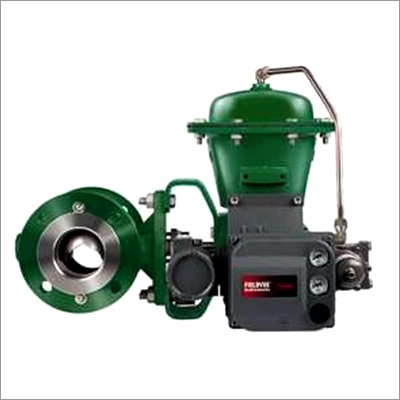
Process plants across the United Arab Emirates rely on rotary control valves that can throttle accurately, seal tightly, and withstand demanding operating conditions over long service intervals. The Fisher Vee-Ball Valve is one of the most widely specified segmented-ball control valves in oil and gas, petrochemical, power, and water treatment facilities worldwide. This article provides a factual, technical overview of the valve family — its design, specifications, materials, and typical applications — with specific relevance to procurement and engineering teams operating in the UAE.
What Is This Product?
This product is a segmented-ball rotary control valve manufactured by Emerson under the Fisher brand. It uses a V-notch ball element that rotates against a fixed seat to regulate flow. As the ball rotates, the V-shaped opening progressively exposes more or less flow area, producing a modified equal-percentage flow characteristic suited to both throttling and on-off service. The design is available in three primary body styles: the V150 (flanged), the V200 (flangeless, wafer-style), and the V300 (flanged, extended pattern for higher-pressure or high-temperature service).
The valve’s core components include the segmented ball, a shaft connected to a rotary actuator, a seal ring at the body inlet, and bearings that support smooth rotational movement. Because the seal and ball assembly can be inspected and replaced from the valve inlet without removing the actuator, maintenance downtime is reduced compared to many alternative rotary or globe valve designs.
Technical Specifications
Understanding the specification range of this rotary control valve helps engineers match the product to process conditions before requesting a quotation.
- Sizes: Available from NPS 1 through NPS 24 (DN 25 through DN 600), covering small instrumentation lines through large process headers.
- Pressure Classes: Body ratings from Class 150 through Class 600, with materials suited to ASME B16.34 pressure-temperature limits.
- Body Materials: Carbon steel (WCC), stainless steel (CF8M, CF3M), and Alloy 6 or other corrosion-resistant options for sour or corrosive service.
- Ball and Trim Materials: Hardened stainless steel or Alloy 6 segmented balls, with HD (heavy-duty) seal rings available for extended cycle life in erosive or high-differential-pressure applications.
- Flow Characteristic: Modified equal-percentage, achieved through precision contouring of the V-notch.
- Rangeability: Typically greater than 100:1, allowing accurate control across a wide span of flow rates.
- Shutoff Class: Class IV or Class V bubble-tight shutoff, depending on seal selection.
- Sour Service Compliance: Constructions available to meet NACE MR0175 and MR0103 requirements for hydrogen sulfide environments, an important consideration for upstream and midstream oil and gas facilities.
- Actuation: Compatible with a range of rotary-shaft pneumatic, electric, and hydraulic actuators, along with FIELDVUE digital positioners for advanced diagnostics.
These specifications place the Fisher Vee-Ball Valve in a versatile category, applicable to clean fluid service as well as slurries, fibrous suspensions, and process streams containing solids.
Reliability and Precision in Operation
Two characteristics distinguish this valve family in demanding process environments: reliability and precision.
Reliability stems from the pressure-balanced seal design, which reduces the torque needed to operate the valve and limits wear on the seal ring over repeated cycles. The solid seal construction is engineered for extended service life even in applications involving abrasive or high-velocity fluids. Because the flanged body design (V150 and V300) removes exposed line-flange bolting from the pressure boundary, installation alignment is simplified and long-term piping integrity is supported.
Precision comes from the geometry of the V-notch ball itself. The contour is machined to deliver predictable, repeatable flow response across the valve’s operating range, which is critical for control loops that must maintain tight tolerances on flow, pressure, or level. When paired with a digital positioner, the valve can provide diagnostic feedback on stroke accuracy, friction, and seat contact — useful data for predictive maintenance programs in facilities that prioritize asset reliability.
Typical Use Cases
This valve family is specified across a range of industrial sectors, including:
- Upstream and midstream oil and gas: Wellhead choke and production manifold applications, separator level control, and sour gas service where NACE compliance is required.
- Refining and petrochemical processing: Throttling service on hydrocarbon streams, including applications involving solids, coking tendencies, or high-viscosity fluids.
- Power generation: Boiler feedwater, condensate, and cooling water control where tight shutoff and long cycle life are priorities.
- Water and wastewater treatment: Sludge, slurry, and fibrous-media handling, where the unobstructed flow path of the V-notch ball resists clogging better than many globe-style alternatives.
- Pulp, paper, and mining: Applications involving abrasive slurries that would quickly erode conventional valve trim.
Relevance for UAE Process Industries
The UAE’s industrial base — spanning upstream and downstream oil and gas operations in Abu Dhabi, petrochemical complexes in Ruwais, desalination and power plants along the coast, and district cooling networks across the Emirates — places sustained demand on control valves that can handle high ambient temperatures, sour service conditions, and continuous-duty cycles. The Fisher Vee-Ball Valve is well suited to these conditions for several reasons.
First, sour service materials compliant with NACE MR0175 are directly relevant to UAE upstream facilities where hydrogen sulfide content is a known process consideration. Second, the valve’s compact, flangeless (V200) and flanged (V150/V300) footprint options accommodate both new-build projects and brownfield retrofits, which are common as UAE facilities expand or modernize existing units. Third, the availability of corrosion-resistant trim materials supports applications in coastal and marine-adjacent facilities where humidity and salinity accelerate material degradation.
For procurement teams sourcing through a regional distributor or channel partner, specifying this valve line allows alignment with an established global product line while working with local support for spare parts, technical documentation, and lead-time planning — a practical consideration for maintenance planning across UAE industrial zones.
Selecting the Right Vee-Ball Configuration
When evaluating this valve for a specific application, engineers typically review the following parameters together with their process data sheet:
- Required flow coefficient (Cv) range and rangeability
- Shutoff class needed for the application (Class IV vs. Class V)
- Body material compatibility with the process fluid
- Pressure and temperature rating against the piping class
- Actuator sizing and whether digital positioning/diagnostics are required
- NACE compliance requirements, where applicable
Working through this checklist with a qualified valve supplier helps ensure the selected configuration matches both current operating conditions and any anticipated turndown or future capacity changes.
Conclusion
The Fisher Vee-Ball Valve remains a benchmark segmented-ball control valve for applications requiring precise throttling, dependable shutoff, and long service life under demanding process conditions. Its broad size and pressure range, combined with materials suited to sour and corrosive service, make it a practical choice for oil and gas, petrochemical, power, and water treatment facilities across the UAE. Engineers and procurement managers evaluating rotary control valve options can use the specifications and selection criteria outlined above as a starting point for technical discussions with their valve supplier.
Frequently Asked Questions
What industries commonly use this valve?
It is used in oil and gas production, refining, petrochemical processing, power generation, water and wastewater treatment, and pulp and paper operations, particularly where throttling accuracy or slurry handling is required.
What sizes and pressure classes are available?
The valve family covers NPS 1 through NPS 24 and body ratings from Class 150 through Class 600, allowing it to be applied across small instrumentation loops and large process headers alike.
Is the valve suitable for sour gas service?
Yes. Material constructions are available that comply with NACE MR0175 and MR0103 standards for applications involving hydrogen sulfide and other sour process conditions.
How does the V-notch ball design differ from a standard ball valve?
Unlike a standard ball valve with a circular port, the segmented V-notch ball provides a contoured opening that produces a modified equal-percentage flow characteristic, making it suitable for both precise throttling and on-off duty.
Can the valve be maintained without removing the actuator?
Yes. The seal ring and ball assembly can be accessed and serviced from the valve body inlet, which reduces the time and labor required for routine maintenance compared to designs that require full actuator removal.
Why is this valve relevant to UAE process facilities?
UAE oil and gas, petrochemical, and desalination facilities often operate under sour service, high-temperature, and continuous-duty conditions. The valve’s NACE-compliant material options, corrosion-resistant trim, and compact body configurations make it applicable to both new installations and retrofit projects in the region.
What actuation options are compatible with this valve?
It can be paired with pneumatic, electric, or hydraulic rotary-shaft actuators, and is compatible with digital positioners that provide stroke and diagnostic feedback for predictive maintenance programs.