

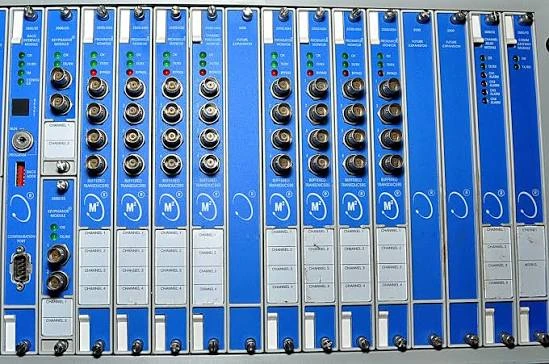
Picture a control room during a compressor startup. Vibration readings are climbing, everyone’s watching the trend screens, and somewhere in a rack down on the plant floor, a small module in Slot 1 is quietly doing the job that makes those screens possible at all. That module is the Bently Nevada 3500/22M and most engineers only think about it the day it stops talking to System 1.
The Module Nobody Notices Until It’s Gone
Officially, this part is called the Transient Data Interface, or TDI. It doesn’t measure vibration, it doesn’t drive a trip relay, and it isn’t part of the rack’s actual protection logic. What it does is arguably just as important: it’s the thing that gets machine data out of the rack and onto the screen where a human being can actually see it.
Before the TDI generation, that job belonged to the 3500/20 Rack Interface Module, paired separately with a communication processor like TDXnet. Bently Nevada folded both jobs into one board. The result is a module that sits in the RIM slot, next to the power supplies, and continuously pulls both steady-state readings and transient waveform data from every M-series monitor in the rack the 3500/40M, the 3500/42M, whatever’s installed then pushes it out over Ethernet to System 1 Condition Monitoring and Diagnostic software.
A Startup Tells the Real Story
Go back to that compressor startup. During steady-state operation, most plants are perfectly happy with static data, periodic snapshots of vibration and position that confirm nothing has drifted since the last reading. That’s what the module captures by default, no extra hardware needed.
Startups and shutdowns are a different animal. Machine behavior changes fast, and a snapshot every few seconds misses exactly the transient events an engineer would want to review after the fact: a resonance passing through a critical speed, a bearing settling in, a momentary spike that self-corrected. That’s where the optional Channel Enabling Disk comes in. Add it, and the same physical module starts capturing high-resolution transient waveform data instead of just steady readings. For plants running frequent start-stop cycles, that upgrade tends to pay for itself the first time someone needs to diagnose what actually happened during a trip.
Why Some Plants Need Two, and Some Need Three
The Bently Nevada 3500/22M family covers more than one configuration, which is why most installations run a single Standard TDI per rack, and that’s genuinely all they need. But for the highest-value assets the machine trains where a missed trip or a false trip carries real financial or safety consequences; some facilities configure a Triple Modular Redundant setup instead. The TMR version of this module continuously cross-checks data from three separate monitors against each other, and if one starts drifting outside tolerance, it gets flagged in the event log before anyone even notices a problem on the trend screen.
Whether a plant needs Standard or TMR usually isn’t a question this module answers on its own; it’s a decision made earlier, at the design stage, based on what that particular machine train is worth if something goes wrong. Retrofitting from Standard to TMR later is possible, but it’s a bigger project than swapping a single board, since it touches the redundant monitor configuration as well.
What Happens If It Fails
Here’s the detail that tends to surprise people the first time they lose one: a failed TDI doesn’t take the rack’s protection down with it. Trip logic, alarm setpoints, relay outputs all of that lives in the monitor modules and the rack backplane, independent of whether the communication module is working. What you lose is visibility. The rack keeps protecting the machine; you just stop being able to see what it’s seeing until the module is replaced.
That distinction matters for how urgently a replacement needs to ship. It’s not always an emergency in the safety sense but it is an emergency in the “we’re currently flying blind on a critical asset” sense, which is its own kind of urgent.
The Physical Details, Briefly
For anyone confirming fit before ordering: the module measures roughly 241.3 mm x 24.4 mm x 241.8 mm and weighs about 0.91 kg. It has a USB-B port on the front for local configuration and a physical keylock reset button, plus a rear I/O module copper or fiber Ethernet, depending on what your plant’s network infrastructure uses. It’s rated to operate from -30°C to +65°C, which covers most industrial environments without additional enclosure requirements.
Sourcing One Without the Guesswork
The part where people usually get stuck isn’t understanding what the module does — it’s confirming exactly which variant their rack needs before placing an order. Standard versus TMR, copper versus fiber I/O, new versus tested-and-repaired get any of those wrong and you’ve got a board that doesn’t do what your rack needs, sitting in a box while the real one is still on order.
Evaflux, operated by Valfux Electric Private Limited, stocks Bently Nevada 3500 series hardware including TDI modules, monitor modules, racks, and probes, backed by an in-house repair team that specializes in this exact category of equipment. Every unit is tested before it ships, and repaired parts carry a 12-month conditional warranty which matters more for a communication module than almost anything else in the rack, since the whole point of buying one is to stop flying blind.
If your facility is planning a rack refresh or replacing a failed unit, send the Evaflux team your exact configuration Standard or TMR, I/O type, and whether transient capture is needed so the right build of the Bently Nevada 3500/22M ships the first time, not the second.