

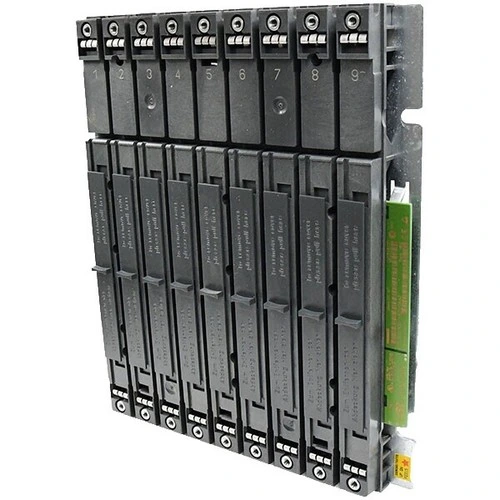
Industrial automation projects depend on control hardware that performs consistently under demanding conditions, and the Siemens 6ES7414-2XK05-0AB0 is a well-known example of this category of equipment. As a central processing unit within the SIMATIC S7-400 family, this module has been deployed across manufacturing plants, process industries, and infrastructure facilities worldwide. This article provides a factual, technical overview of the device, covering its core specifications, communication interfaces, reliability characteristics, and the practical scenarios in which engineers and procurement teams typically source it.
What Is This Product?
This device is a CPU 414-2 module belonging to Siemens’ SIMATIC S7-400 programmable logic controller (PLC) platform. It functions as the central processing unit of an S7-400 automation system, executing control logic, managing I/O data exchange, and coordinating communication with other devices on the plant network. The S7-400 series was engineered for medium- to high-performance automation tasks where modularity, scalability, and long-term availability of replacement parts are priorities for plant operators.
This particular CPU variant is positioned within the mid-range of the S7-400 lineup, offering a balance between processing capability and cost-efficiency that suits a wide range of discrete and process automation applications.
Technical Specifications
Understanding the core technical parameters of the module helps engineers determine whether it fits a given project’s requirements. Key specifications include:
- Product family: SIMATIC S7-400, CPU 414-2
- Work memory: 1 MB total, split as 0.5 MB for program code and 0.5 MB for data
- 1st interface: MPI/DP, supporting communication rates up to 12 Mbit/s
- 2nd interface: PROFIBUS DP, enabling distributed I/O and fieldbus device connectivity
- Form factor: Rack-mounted module compatible with standard S7-400 mounting racks and power supplies
- Programming environment: Configured and programmed using Siemens STEP 7 engineering software
The dual-interface design is a defining feature of the CPU 414-2. The MPI/DP interface is typically used for programming device connections and multi-point communication with other SIMATIC controllers, while the dedicated PROFIBUS DP interface allows the CPU to manage distributed input/output stations directly, reducing the need for additional communication processors in many system architectures.
It should be noted that this CPU has reached end-of-life status within Siemens’ current product portfolio and has been officially succeeded by the Siemens 6ES7414-2XK05-0AB0
. Organizations still operating legacy S7-400 installations continue to source this unit for maintenance, replacement, and spare-parts purposes, since migrating an entire control system to a newer platform is often impractical in the short term.
Reliability and Build Quality
Reliability is one of the primary reasons the S7-400 CPU 414-2 family, including this module, remains in active service across so many industrial facilities. Siemens designed the S7-400 platform for continuous, unattended operation in industrial environments, and the CPU 414-2 reflects that design philosophy in several ways:
- Robust construction suited to control cabinet environments with typical industrial vibration, temperature variation, and electromagnetic interference exposure.
- Deterministic program execution, which is essential for time-critical control tasks in manufacturing and process lines.
- Diagnostic capabilities built into the CPU firmware, allowing maintenance personnel to identify faults quickly and minimize unplanned downtime.
- Backward compatibility with existing S7-400 racks, I/O modules, and PROFIBUS DP network segments, which reduces the risk associated with hardware replacement in older systems.
Because many installations using this CPU have been running for over a decade, its track record in the field provides a practical demonstration of the platform’s durability. This is a significant factor for procurement managers who prioritize minimizing total cost of ownership over the operational lifetime of a control system.
Precision and Control Performance
Precision in a PLC context refers to how accurately and consistently the CPU executes control logic, processes I/O signals, and maintains timing across scan cycles. The CPU 414-2’s memory architecture, with a clear split between code and data memory, supports structured program organization, which in turn helps engineers write control logic that behaves predictably.
The PROFIBUS DP interface also contributes to precision at the system level. By allowing direct, deterministic communication with distributed I/O stations, the CPU can maintain tight synchronization between sensor inputs, actuator outputs, and the control program — a requirement in applications such as motion-related sequencing, batch processing, and coordinated multi-station production lines.
Typical Use Cases
The Siemens 6ES7414-2XK05-0AB0 has historically been deployed across a broad spectrum of industrial sectors. Common application areas include:
- Discrete manufacturing: Coordinating machine sequences, conveyor systems, and packaging lines.
- Process industries: Managing control loops in chemical, water treatment, and utility applications where PROFIBUS DP connects field instrumentation.
- Material handling and logistics: Controlling automated storage and retrieval systems that rely on distributed I/O architecture.
- Infrastructure and building systems: Supervising HVAC, pumping stations, and other facility-level automation tasks.
- Legacy system maintenance: Serving as a direct replacement part for existing S7-400 installations where full system upgrades are not immediately planned or budgeted.
In each of these scenarios, the combination of MPI/DP and PROFIBUS DP connectivity allows the CPU to integrate into established plant communication architectures without requiring extensive rework of existing field wiring or network topology.
Worldwide Applicability and Sourcing
This device has been distributed and installed in industrial facilities across Europe, North America, Asia, and other regions, reflecting the global reach of the SIMATIC S7-400 platform. Because Siemens automation standards, including PROFIBUS DP and STEP 7 programming conventions, are widely adopted internationally, this CPU integrates into control architectures regardless of the country or region in which a facility operates.
This global relevance matters for procurement teams sourcing replacement or maintenance parts. Plants running S7-400 systems anywhere in the world may need to locate a compatible CPU 414-2 unit when a module fails or when a system is being expanded. Evaflux serves this need by connecting international buyers, including engineers, technicians, and procurement managers, with dependable sourcing options for this hardware, supporting continuity of operations for facilities that depend on it regardless of geographic location.
Considerations Before Purchasing
Before acquiring this unit, technical buyers should verify a few practical points:
- Firmware version compatibility with the existing S7-400 rack configuration and STEP 7 project file.
- Confirmation of end-of-life status, since Siemens has designated the 6ES7414-2XL07-0AB0 as the direct successor, which may be worth evaluating for new installations.
- Physical condition and sourcing history of the unit, particularly for buyers acquiring components for critical, continuously operating systems.
- Documentation availability, including manuals and configuration data, to support proper installation and commissioning.
Final Thought
The Siemens 6ES7414-2XK05-0AB0 remains a relevant component for organizations maintaining SIMATIC S7-400 based automation systems. Its 1 MB work memory, dual MPI/DP and PROFIBUS DP interfaces, and proven reliability record make it a practical choice for sustaining discrete manufacturing, process control, and infrastructure automation systems already built on this platform. For engineers and procurement managers evaluating replacement parts or system expansions, understanding these technical characteristics supports informed sourcing decisions, whether the requirement originates from a facility in Europe, the Americas, Asia, or elsewhere.