
ICS Triplex T9110 AADvance Processor Module

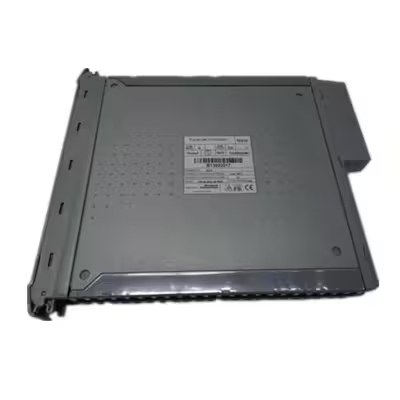

ICS Triplex T9110 AADvance Processor Module
📊 Specifications
| Attribute | Specification |
|---|---|
| Model | T9110 AADvance Processor Module |
| Architecture | TMR (Triple Modular Redundancy) |
| Processor Clock | ~400 MHz (PowerPC 604e or equivalent industrial CPU) |
| Memory | SDRAM ~32 MB, Flash ~64 MB + Boot/SRAM ~512 kB each |
| Safety Integrity Level | SIL 1 (single) / SIL 3 (dual) / SIL 3 (TMR) |
| Power Supply | Redundant 24 V DC nominal (18–32 V DC range) |
| Power Dissipation | ~8 W (27.3 BTU/h) |
| Interfaces | 2× Ethernet, 2× Serial |
| I/O Support | Up to ~48 modular I/O via backplane bus |
| Operating Temp. | Typically −25 °C to +60 °C (industrial range) |
| Dimensions | ~166 × 42 × 118 mm |
| Weight | ~430 g |
Description
Hardware Design and Reliability Assurance
The ICS Triplex T9110 AADvance Processor Module is engineered for high-availability and safety-critical environments. Its hardware design focuses on electrical protection, communication reliability, fault tolerance, and long-term data integrity—ensuring stable operation even under harsh industrial conditions.
1. Electrical Isolation and Power Supply Protection
Full-Range Electrical Isolation
The T9110 processor module uses galvanic isolation for both external power inputs and communication signals. This isolation effectively blocks field-side electrical faults—such as short circuits, surges, or overvoltage—from propagating into the internal electronics. As a result, the core control components are protected from external disturbances, significantly reducing the risk of module damage and system downtime.
Redundant Power Supply with Voltage Protection
The module supports dual redundant 24 V DC power inputs, ensuring continuous operation even if one power source fails. The internal power circuitry includes built-in undervoltage and overvoltage protection, operating safely within a voltage range of 18 to 32 V DC.
If the input voltage moves outside this safe range, the protection mechanism is automatically activated. At the same time, a power-valid status signal is sent to the module’s diagnostic microprocessor, enabling fast fault identification and maintenance response.
2. Communication Interface Configuration
Dual Ethernet Interfaces
The T9110 is equipped with two independent and electrically isolated Ethernet ports (Ethernet 1 and Ethernet 2). Each port can be configured separately and supports multiple industrial communication protocols, including:
Modbus RTU
Open Modbus/TCP
Proprietary AADvance protocol
All processor channels within the controller can share Ethernet data, allowing flexible network architectures and seamless integration into a wide range of industrial control systems.
Serial Communication Ports
Each processor module also provides two isolated serial communication ports, primarily for Modbus RTU slave communication. These ports support RS-485 communication in both 2-wire and 4-wire configurations, offering excellent compatibility with field devices.
The asynchronous communication speed is configurable from 1,200 to 115,200 baud, making the module adaptable to devices with varying communication requirements.
3. Fault Tolerance and Redundancy Capabilities
Flexible Multi-Module Redundant Architecture
The controller can be configured with one, two, or three T9110 processor modules, allowing users to select the appropriate fault-tolerant architecture based on application needs:
1oo2D (1-out-of-2 with downgrade) using two modules
2oo3D or TMR (Triple Modular Redundancy) using three modules
In the event of a processor failure, the remaining modules continue operation without interruption, maintaining system availability and safety.
Online Replacement and Automatic Synchronization
In redundant configurations, a failed processor module can be replaced while the system remains online. Once the new module is inserted, it automatically performs a self-synchronization process, learning configuration data and runtime status from the healthy modules.
This capability eliminates the need for system shutdown, minimizes maintenance time, and ensures uninterrupted production.
4. Backup Battery and Data Protection
The T9110 processor includes a built-in backup battery that activates only when the main system power is completely lost. This battery safeguards critical system data and functions, including:
Real-Time Clock (RTC) Backup
The battery powers the internal real-time clock, ensuring accurate timekeeping during power outages. When power is restored, system time synchronization is immediate, preventing errors in timestamps, alarms, and scheduled tasks.
Conserved Variable Data Retention
At the end of each application scan cycle, conserved variable data is stored in battery-backed RAM. After power restoration, this data is automatically reloaded, allowing the control application to resume operation without reinitialization.
Diagnostic Log Preservation
Critical diagnostic information—such as fault histories and status changes—is stored in battery-backed memory. This ensures that valuable troubleshooting data is retained even after a complete power loss, supporting faster root-cause analysis and maintenance.
Battery Life Expectancy
Up to 10 years under continuous power operation
Approximately 6 months when the module is unpowered (at 25 °C, low humidity)
Environmental factors such as high temperature, high humidity, or frequent power cycling may reduce battery life. Regular inspection and timely replacement are recommended to maintain data protection reliability.
RELATED PRODUCTS
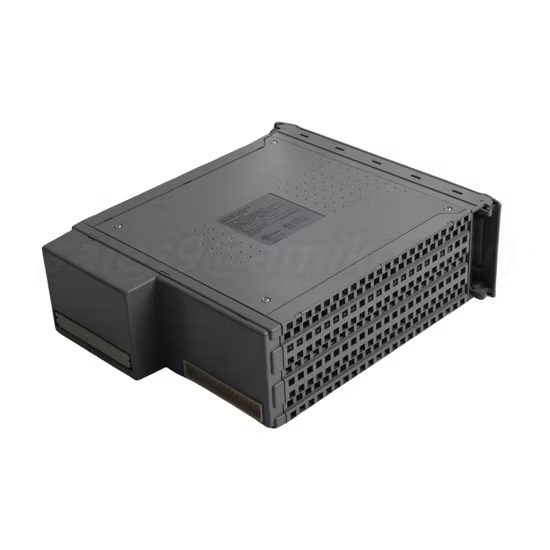
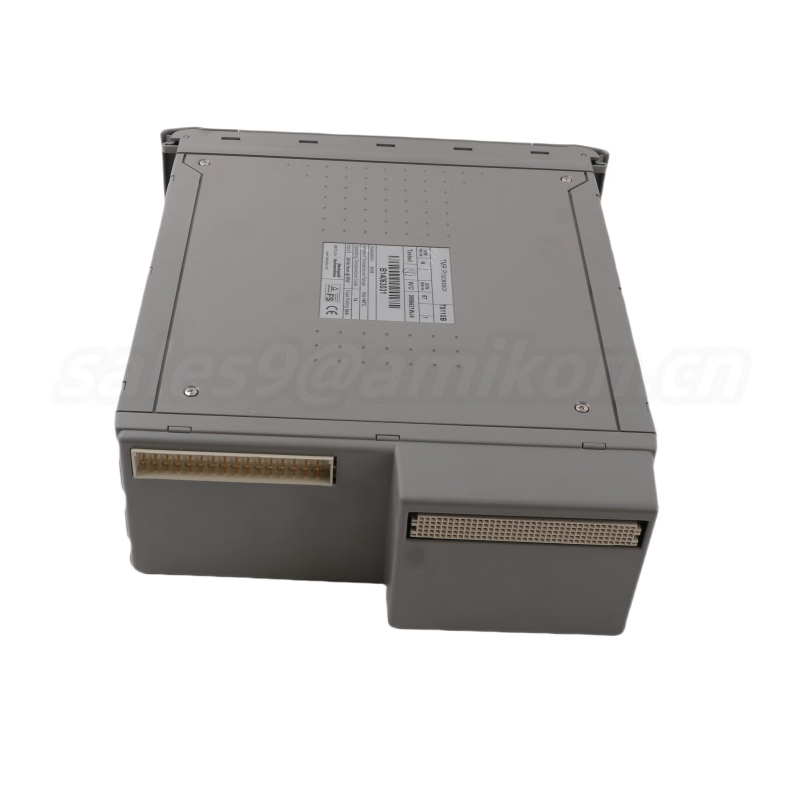
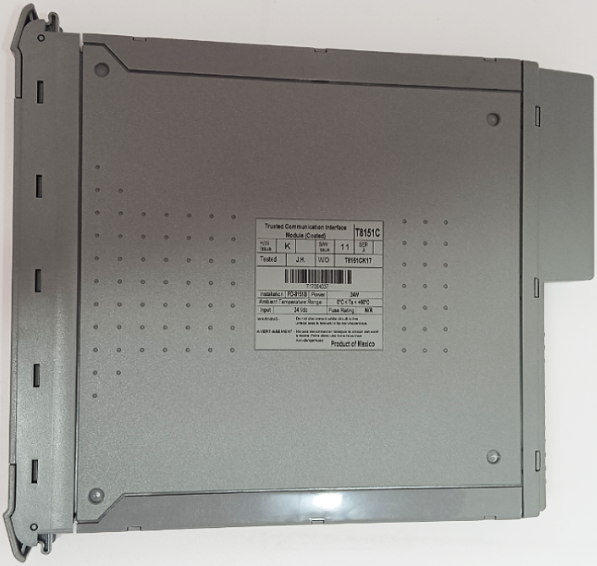



Valfux Electric Private Limited is a professional supplier specializing in original brand-new PLC and DCS automation parts from world-renowned manufacturers. Our extensive inventory features trusted brands such as Allen Bradley, Bently Nevada, Honeywell, ABB, GE Fanuc, Siemens, Invensys Triconex, ICS Triplex, Foxboro, Yokogawa, Schneider Electric, HIMA, and more.
Know more about our products and services on evaflux.com and get the update on latest products and services anywhere worldwide. Read more…




</label>
<input type="file" name="ef_file" id="ef_file" accept=".pdf,.jpg,.jpeg,.png">
</div><input type="hidden" name="product_name" value="ICS Triplex T9110 AADvance Processor Module">
<input type="hidden" name="action" value="evaflux_send_quote">
<button type="submit" id="ef-submit-btn">
<span class="btn-text">Submit Inquiry</span>
</button>
</form><div id="ef-success-modal" class="ef-modal-overlay">
<div class="ef-modal-content">
<div class="ef-checkmark">✓</div>
<h3>Request Received</h3>
<p>Thank you. Your technical requirements and files have been sent to our support team. Check your inbox for confirmation.</p>
<button type="button" onclick="document.getElementById('ef-success-modal').style.display='none'">Close</button>
</div>
</div>
</div><style>
:root { --ef-orange: #eb4f0c; --ef-dark: #222222; }
.ef-quote-container { border: 1px solid #eee; background: #fff; margin: 20px 0; border-radius: 4px; overflow: hidden; }
.ef-header { background: var(--ef-dark); padding: 15px 20px; color: #fff; }
.ef-header h4 { color: #fff; margin: 0; text-transform: uppercase; font-size: 16px; letter-spacing: 1px; }
.ef-header p { color: var(--ef-orange); margin: 5px 0 0; font-size: 12px; font-weight: 700; }
.ef-form { padding: 20px; display: flex; flex-direction: column; gap: 15px; }
.ef-row { display: grid; grid-template-columns: 1fr 1fr; gap: 15px; }
.ef-form input, .ef-form textarea { border: 1px solid #ddd; padding: 12px; font-size: 14px; }
.ef-file-upload { background: #f9f9f9; padding: 10px; border: 1px dashed #ccc; }
.ef-file-upload label { display: block; font-size: 11px; font-weight: bold; margin-bottom: 5px; color: #666; text-transform: uppercase; }
#ef-submit-btn { background: var(--ef-orange); color: #fff; border: none; padding: 16px; font-weight: 700; text-transform: uppercase; cursor: pointer; transition: 0.3s; }
#ef-submit-btn:hover { background: #000; }
.ef-modal-overlay { display: none; position: fixed; top: 0; left: 0; width: 100%; height: 100%; background: rgba(0,0,0,0.85); z-index: 99999; align-items: center; justify-content: center; }
.ef-modal-content { background: #fff; padding: 40px; text-align: center; max-width: 400px; border-top: 6px solid var(--ef-orange); }
.ef-checkmark { width: 60px; height: 60px; background: var(--ef-orange); color: #fff; border-radius: 50%; font-size: 30px; line-height: 60px; margin: 0 auto 20px; }
@media (max-width: 768px) { .ef-row { grid-template-columns: 1fr; } }
</style><script>
jQuery(document).ready(function($) {
$('#ef-ajax-quote-form').on('submit', function(e) {
e.preventDefault();
var formData = new FormData(this); // Necessary for file uploads
$('#ef-submit-btn').prop('disabled', true).text('Processing...');$.ajax({
url: 'https://evaflux.com/wp-admin/admin-ajax.php',
type: 'POST',
data: formData,
contentType: false,
processData: false,
success: function(response) {
if(response.success) {
$('#ef-success-modal').css('display', 'flex');
$('#ef-ajax-quote-form')[0].reset();
} else {
alert('Error: ' + response.data);
}
$('#ef-submit-btn').prop('disabled', false).text('Submit Inquiry');
}
});
});
});
</script>)
Reviews
There are no reviews yet.